US Jobs in 2026: What Is Actually Being Hired Right Now
Ankush Wadhwa

The United States job market rewards specificity. A candidate who searches for any role in any state usually ends up with a generic résumé, weak evidence and no reliable way to learn from rejection. A stronger search starts with a concrete role family, a realistic location plan and a clear account of the problems you can solve. Base Career tracked 76,917 active US postings scraped in the trailing 30 days to 19 August 2026. This guide turns that aggregate snapshot into a practical search strategy.
The figures in this guide describe aggregate postings tracked by Base Career. They are directional evidence, not a census of every US vacancy, employer or occupation.
What Current US Postings Show
Clinical and commercial roles dominate the exact-title counts. Pharmacy Technician led with 1,164 postings, followed by Sales Representative with 817. Customer Service Representative appeared 791 times, Cashier 727, Account Executive 580, Brand Ambassador 468 and Optometrist 417. Behavior Technician had 304 postings, Project Manager 282 and Senior Software Engineer 276, with Registered Nurse at 236.
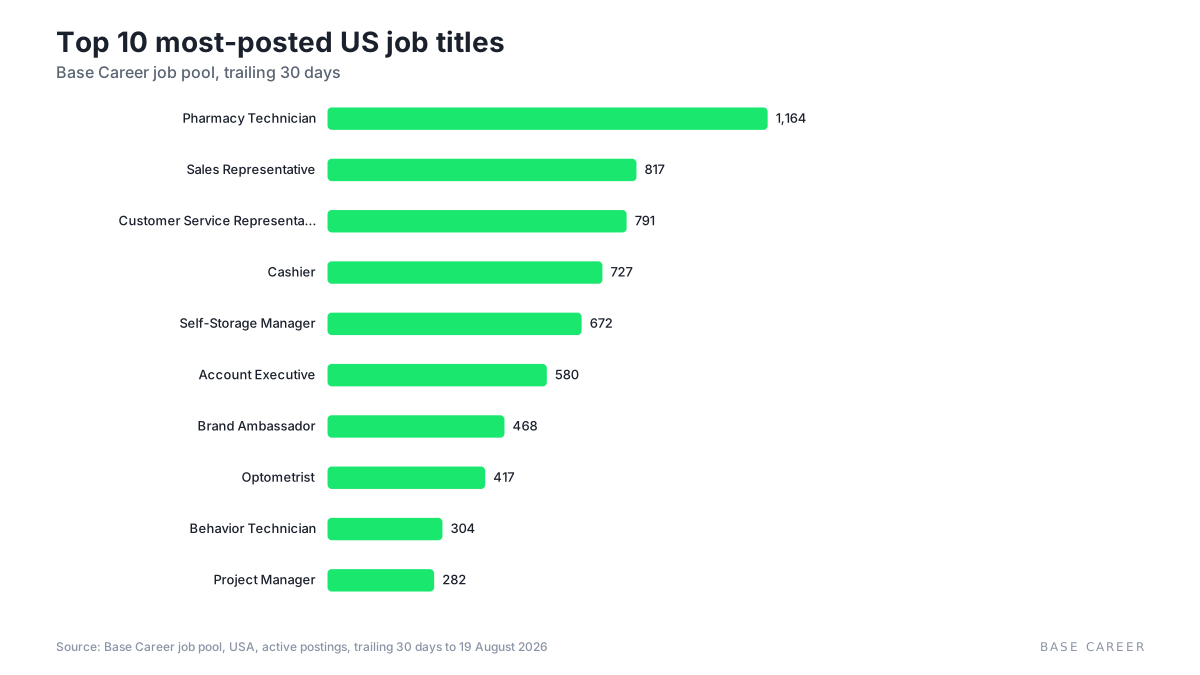
These are exact-title counts rather than whole-occupation totals. Employers describe similar work with different titles, and a single employer can mass-post one title across many sites. The fifth row, “Self-Storage Manager,” reflects that pattern: one title repeating at 672 entries is not the same signal as 672 distinct employers. Read the chart as search vocabulary, not as a promise that any one occupation is easy to enter.
The pattern suggests several role families worth separating. A clinical lane could combine Pharmacy Technician, Optometrist and Registered Nurse, but each carries different licensing and education requirements. A commercial lane could combine Sales Representative, Account Executive and Brand Ambassador, though pay structures differ. A technology lane might include Senior Software Engineer and Software Engineer, where delivered systems matter. A customer-support lane could cover Customer Service Representative and Cashier. Match your experience to responsibilities, not titles alone.
Choose a Role Family, Not a Single Keyword
A role family is a small, coherent group of titles that demand similar evidence. Start with one primary title, then add close alternatives that reflect work you have actually done. If you have run a sales pipeline, negotiated contracts and developed accounts, commercial titles may belong together. If your background is clinical, patient-facing care, a healthcare lane is more credible. Combining unrelated targets weakens the opening of your résumé because the reader cannot tell what you are offering.
Read current adverts from that family and note recurring responsibilities, tools, stakeholders and outcomes. Do not copy sentences from job descriptions. Translate your own evidence into language employers use only when it remains accurate. If a vacancy asks for client acquisition, show how you found, qualified or developed clients. If it asks for software delivery, show the systems, scope and results you shipped.
Target Locations With Data Quality in Mind
The current pool concentrates its strongest location values in a handful of metros, but the raw fields contain multiple labels for the same place. The query returned 4,381 postings under “New York” and another 906 under “New York City.” San Francisco accounted for 3,639, Austin 1,875, Chicago 1,768 and Boston 1,336. A further 12,460 postings had no usable city value at all.
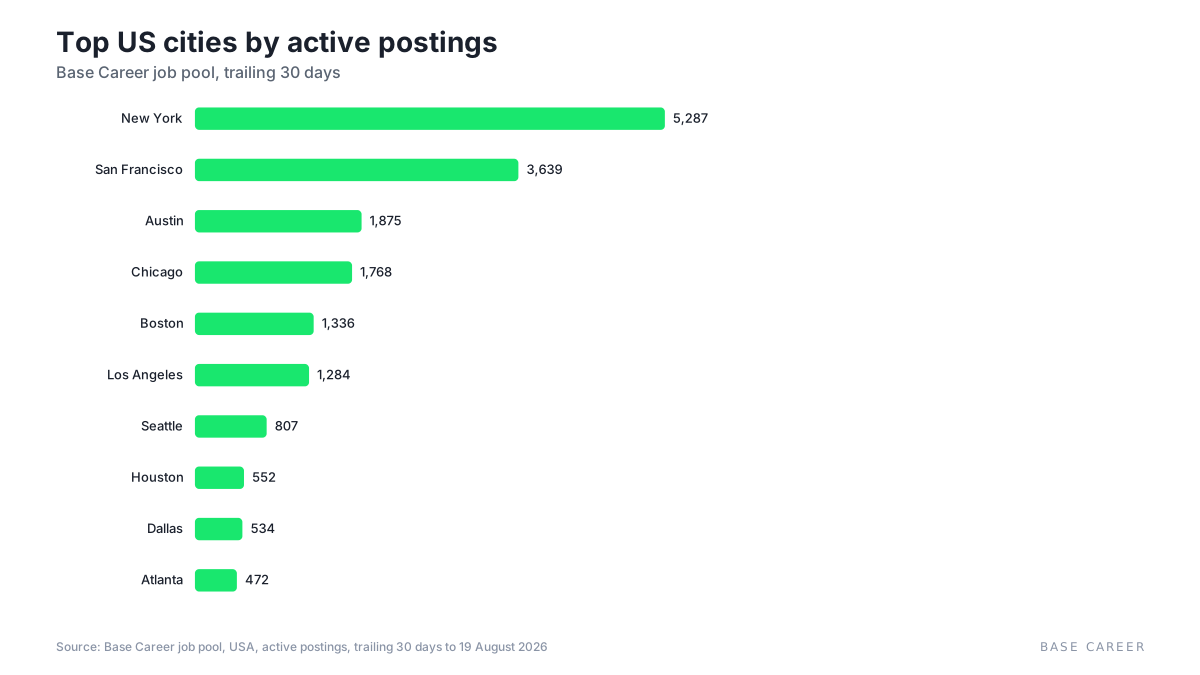
That field fragmentation is a warning against false precision. The data supports a broad conclusion that New York, San Francisco, Austin, Chicago and Boston are major centres in this tracked pool, but it should not be converted into a clean market-share claim without normalising every location. For your search, use location as a practical filter. Decide where you can work, what commute or relocation is realistic and whether the role is genuinely on-site, hybrid or remote, and verify the workplace expectation in the employer’s own vacancy.
A two-lane location plan usually works better than searching the whole country without context. Make one metro your primary lane based on your network, sector and logistics. Add a secondary lane only where your experience has credible demand and the move is workable. State your current location and realistic availability clearly, and never claim a work location you cannot support.
Use Salary Fields Cautiously

“I kept getting rejections from London. Base Career rewrote my CV for Dubai, and I landed Emirates in 3 weeks.”
Sarah M. · Marketing Manager · UK 🇬🇧 → Dubai 🇦🇪
No credit card required
Salary information is especially thin in this US dataset. The aggregate query found a non-empty salary field in only about 4.9% of the 76,917 active postings. That coverage is too sparse to treat any visible range as representative of a title, industry or seniority level. Where a figure does appear, confirm the period, currency and whether it includes commission, bonus or allowances before comparing roles.
For reliable compensation context, use the U.S. Bureau of Labor Statistics rather than a single advert. The BLS Employment Projections 2024–2034 list median annual wages for software developers at $133,080, data scientists at $112,590 and nurse practitioners at $129,210. The BLS Employment Situation for July 2026 puts average private-sector hourly earnings at $37.62, up 3.2% year over year. Benchmark against national figures, not a single advert.
Understand Work Authorization Before You Apply
US work authorization is a hard gate, so research it before building an application. Most skilled professional roles that sponsor visas use the H-1B category. The USCIS H-1B page notes a congressionally mandated cap of 65,000 new H-1B visas each fiscal year, plus 20,000 for graduates of US advanced-degree programmes, and USCIS reported that it had received enough petitions to reach both caps for fiscal year 2027. Because demand regularly exceeds supply, sponsorship is selective and timing matters.
If you are in the United States on an F-1 student visa, employment is structured through practical training rather than sponsorship alone. The USCIS Students and Employment page explains that F-1 students may not work off campus during the first academic year, then may use Curricular Practical Training (CPT), Optional Practical Training (OPT) or the STEM OPT extension, and the USCIS Students and Exchange Visitors page sets out the wider F, M and J categories. Permanent-residency paths sit under the USCIS Green Card guidance. These rules can change, so confirm the current position against the official source behind each claim.
Build an ATS-Readable US Résumé
US recruiters and applicant tracking systems reward machine-readable, evidence-first documents. Use conventional headings, simple chronology and readable text. Put important information in the document body rather than decorative graphics, icons, headers or footers. Keep job titles honest, then add a short explanation where an internal title would be unclear to an external recruiter. Use American spelling and US date conventions unless an employer requests another style.
Lead with a concise target and the evidence most relevant to that target. Each recent role should explain the problem, your action and the result. Metrics help only when you can substantiate them. A sales candidate might show pipeline ownership, conversion improvement or account growth without exposing confidential client information. A software candidate might show delivered systems, scope and team impact. A clinical candidate might show patient volume, accuracy and compliance.
Keyword alignment should remain truthful. If a tool, method or sector term appears repeatedly in relevant vacancies and you have used it, place it beside the achievement that proves your experience. If you have not used it, do not add it to pass a filter. Recruiters can test shallow claims quickly, and an interview built on inflated keywords is difficult to recover.
Use Base Career’s current US job search to inspect live opportunities and recurring role language, or browse all current jobs. For a complementary market guide in this series, see how to approach the Canada job search in 2026 or the UAE jobs guide in 2026. The location and work-rights context differs, but the core discipline transfers: choose a role family, target locations deliberately, build evidence and measure results.
Turn Labor-Market Trends Into Evidence
The national picture supports a disciplined search. The BLS Employment Situation for July 2026 reported an unemployment rate of 4.1%, with nonfarm payroll employment little changed in July and health care continuing to add roles. Use that direction to choose your lane, then return to current vacancies for role-level decisions. A national statistic cannot tell you whether a particular US employer needs your sector knowledge, licence, language ability or network.
Use the BLS projections as a planning lens, not a fantasy list. Across all occupations the BLS projects about 5.2 million net new jobs to 2034, an increase of roughly 3.1%. Software developers are projected to add about 267,700 roles, up 15.8%, and nurse practitioners to grow by about 40%. If a demanding role family you favour is projected to grow, plan the evidence and, where needed, the credential it will take.
Build a skill plan around observable gaps. If several relevant adverts ask for the same capability and you lack it, decide whether to learn it, demonstrate an adjacent strength or stop targeting that lane. A course can support the plan, but evidence matters more than a badge. Create a practical project, improve a work sample where confidentiality allows, or prepare a clear account of how you solved a related problem.
Run a Measured Application Campaign
Separate discovery from application. First, collect suitable vacancies and remove those that fail essential requirements. Next, tailor the strongest applications by changing the target summary, evidence order and truthful terminology. Then record the role, company, city, source, résumé version and next action. A tracker prevents duplicates and shows which role family earns useful responses.
Review outcomes by stage. If few discovered roles are genuinely suitable, narrow or revise the target. If strong applications produce no screening calls, inspect role fit, evidence and document clarity. If interviews repeatedly stop at the same topic, prepare that area more deeply. Change one major variable at a time so the next result teaches you something.
Networking should improve information, not replace fit. Ask focused questions about a function, sector or team rather than opening with a request for a referral. A useful conversation can reveal local title variations, hiring cycles and the evidence a hiring manager values. Apply those lessons to your role family and résumé while keeping every claim accurate.
A Practical Plan for Your Next Week
- Pick one role family and list its three most common titles from current US vacancies.
- Confirm your work-authorization position against current USCIS guidance.
- Choose one primary metro and one secondary lane you can genuinely support.
- Rewrite your résumé so every claim maps to a role-specific piece of evidence.
- Track one week of applications and review which family earns responses.
The current posting pool points to meaningful demand across clinical, commercial, technology and customer-service work. It does not remove competition, guarantee suitability or replace careful reading of each vacancy. Your advantage comes from disciplined positioning: a coherent target, evidence that matches the work, realistic location choices and a feedback loop that improves the next application.
Sources and Methodology
Base Career figures come from aggregate queries executed on 19 August 2026 over active US postings scraped in the trailing 30 days. The run measured the total pool, exact-title counts, city values, salary-field coverage and employment-type values. Of postings that carried a recognisable employment-type value, the pool showed about 83.5% full-time, 11.8% part-time and 3.8% contract; many postings carried no usable value at all. Official market context came from the U.S. Bureau of Labor Statistics and work-authorization context from USCIS, all fetched on 19 August 2026. No individual job descriptions, users, résumés, applications or customer records were retrieved.
- USCIS, “H-1B Specialty Occupations,” https://www.uscis.gov/working-in-the-united-states/h-1b-specialty-occupations (accessed 19 August 2026)
- USCIS, “Students and Employment,” https://www.uscis.gov/working-in-the-united-states/students-and-exchange-visitors/students-and-employment (accessed 19 August 2026)
- USCIS, “Students and Exchange Visitors,” https://www.uscis.gov/working-in-the-united-states/students-and-exchange-visitors (accessed 19 August 2026)
- U.S. Bureau of Labor Statistics, “Employment Situation — July 2026,” https://www.bls.gov/news.release/empsit.nr0.htm (accessed 19 August 2026)
- U.S. Bureau of Labor Statistics, “Employment Projections — Fastest Growing Occupations 2024–2034,” https://www.bls.gov/emp/tables/fastest-growing-occupations.htm (accessed 19 August 2026)
Frequently Asked Questions
Is it hard to get a US job without visa sponsorship?+
Which US jobs appear most often on Base Career right now?+
How much do US jobs pay?+
Land 4x more interviews in 27 days. Join Base Career Today.
Track applications, tailor resumes, and follow up faster in one UAE job search system.
Start freeNo credit card required

James T.
Canada 🇨🇦 → Riyadh 🇸🇦
“50 applications, zero replies with my Canadian CV. Base Career got me 4 Riyadh interviews and a Series B offer.”
Written by Ankush Wadhwa
Helping you accelerate your career with AI-powered tools.
Related Posts

وظائف جدة 2026: A Bilingual Map for Jeddah Job Search
A data-backed Jeddah job-search guide with bilingual role lanes, live category routes, official work-status checks and a safer application workflow.

Jobs in Dubai: What the Latest Posting Mix Means for Your Search
A current Dubai job-market guide using fresh posting data, official search routes, work-permit guidance and practical offer checks.