USA Hiring Reality in 2026: Work Rights, ATS and Pay
Ankush Wadhwa
USA Hiring Reality in 2026: Work Rights, ATS and Pay
The United States is a large, competitive job market, but a large market is not the same thing as a simple one. A strong search starts with work-authorisation reality, a résumé that an employer's hiring workflow can read, and a salary conversation grounded in the occupation rather than a random internet estimate. This guide turns those three questions into a practical process for local candidates, international applicants and people returning to the market.
The aim is not to promise a shortcut or to tell you that every employer uses the same screening software. It is to help you decide which roles to target, what to show in your application, how to check whether a role can employ you, and when a posting deserves caution. For live opportunities, start with the Base Career jobs directory, then use the checklist below to qualify each application.
A focused USA job search begins with eligibility, evidence and a repeatable application process.
What the fresh USA job-pool signal says
In the aggregate Base Career jobs_pool query run on 21 August 2026, the USA slice contained 81,470 active postings scraped within the previous 30 days. That is a directional view of the pool, not a count of unique vacancies across the entire country: titles can vary, postings can change, and the data is not a promise that every role remains open when you click it.
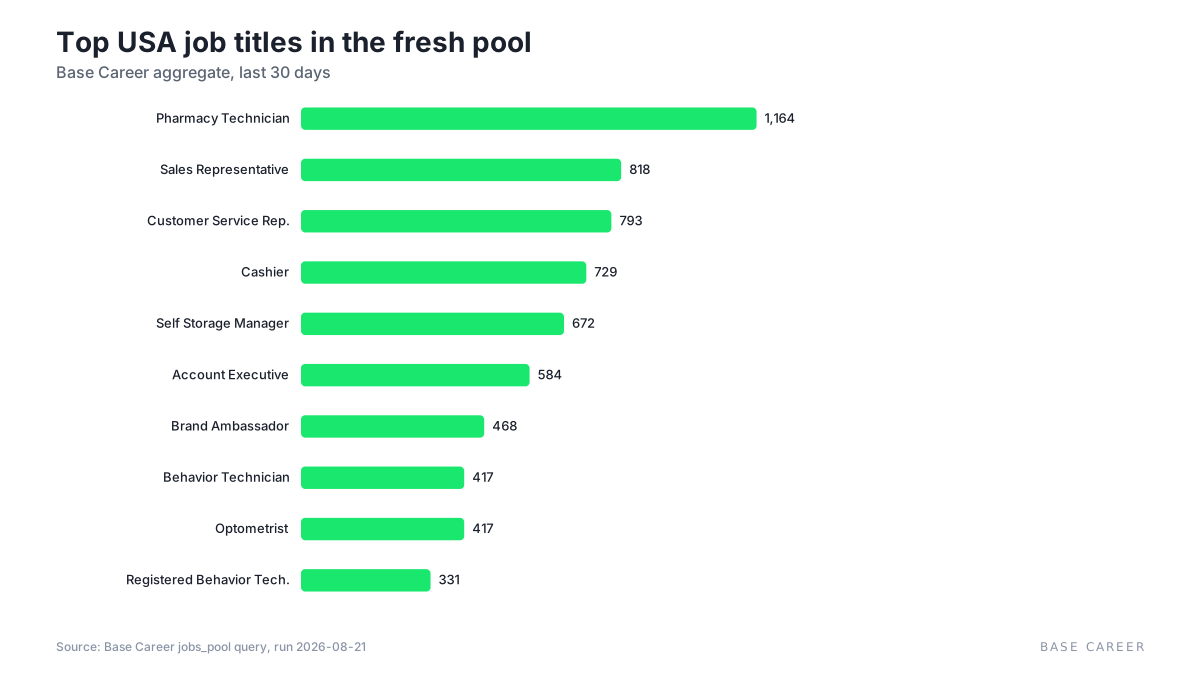
The leading title families in that fresh slice were Pharmacy Technician, Sales Representative, Customer Service Representative and Cashier. Account Executive, Brand Ambassador, behaviour-focused technician roles, Optometrist, Project Manager, Senior Software Engineer and Registered Nurse also appeared in the leading group. The useful lesson is breadth: a USA search should not assume that only software or finance roles are viable. Match your search to your evidence, then narrow by employer, location, seniority and eligibility.
Original Base Career aggregate. It describes the fresh pool captured in this run, not the whole US labour market.
Location is a filter, not a verdict. New York and San Francisco were the largest named city groups in the same query, followed by Austin, Chicago, Boston, Los Angeles, Seattle, Dallas, Houston and Atlanta. A missing city can also mean that the posting did not carry a usable normalized location, so do not interpret an unnamed location as a low-demand market.
Start with work authorisation, not optimism
If you are already authorised to work in the USA, say so accurately and follow the employer's instructions. If you need authorisation, do not treat a generic application form as proof that sponsorship is available. USCIS's working-in-the-United-States overview describes employment-based nonimmigrant and immigrant classifications as well as other categories of people who may be authorised to work. Your status, the role, the employer and the filing path all matter.
For a role that may involve a specialty-occupation route, read the USCIS H-1B specialty occupations page rather than relying on a recruiter slogan. It explains the category's scope and requirements. This is not immigration advice; it is a reminder to verify the official category and obtain qualified advice when your decision depends on it.
Write your current work-authorisation position in plain, accurate language; never claim sponsorship, permanent residence or eligibility that you do not have.
Check whether the employer's posting or careers page addresses sponsorship, location restrictions or remote-work eligibility.
Ask a precise question before investing in a long process: can this employer consider a candidate who needs the relevant employment-authorisation route for this role?
Keep copies of the public posting and the employer identity so you can verify later if the wording changes.
A good application is not only a match between your skills and the role. It is also a match between the employer's hiring authority, location rules and your right to work.
For federal opportunities, use USAJOBS, which identifies itself as the federal government's official employment site. A federal application can have different eligibility questions and document requirements from a private-sector application, so do not reuse a private-sector résumé without checking the vacancy instructions.
Choose a target role before rewriting your résumé
A broad search creates a broad résumé, and a broad résumé makes it difficult for a recruiter to see the match. Pick a primary role family and a small set of adjacent titles. For example, a customer-service search might include Customer Service Representative, Client Support Specialist and Contact Centre Representative. A sales search might include Sales Representative, Account Executive and Business Development Representative. Keep the target family coherent enough that your headline, skills and achievements tell the same story.
Use the fresh Base Career signal as a starting point, not as a command. Pharmacy Technician was the largest exact title in this run's USA slice, while sales, service, retail and specialist healthcare titles also featured strongly. If your background sits outside those groups, the right response is not to force an unrelated title into your résumé. Search the directory for your real role family and build proof around the outcomes employers ask for.
“I kept getting rejections from London. Base Career rewrote my CV for Dubai, and I landed Emirates in 3 weeks.”
Applicant-tracking software is a workflow, not a magic ranking engine. Employers configure systems differently, and a person still decides whether your evidence is credible. The practical goal is simple: make the document easy for both systems and people to parse. Use conventional section names, a clear employment chronology, readable text, and the same role language that accurately describes your experience.
Start with a target headline that names the role family and your strongest value area.
Mirror important skills from the vacancy only when you can support them with real work, training or a portfolio example.
Turn responsibilities into evidence: what changed, improved, shipped, resolved or grew because of your work.
Keep dates, employers, locations and job titles consistent across the résumé, application form and professional profile.
Export a clean text-readable file and inspect the extracted text before you submit it.
Avoid decorative layouts that hide dates or put critical information inside images. Avoid keyword stuffing, unexplained acronyms and a skills list that is longer than your evidence. A concise résumé with specific outcomes usually gives a reviewer more confidence than a dense document that tries to cover every possible role.
Before submitting, compare your résumé against the vacancy in three passes: role language, evidence and logistics. Role language checks whether the target title is clear. Evidence checks whether each important requirement has a credible example. Logistics checks work location, schedule, work authorisation and any requested documents. This is the part of the process where a focused Base Career workflow can save time without replacing your judgement.
Treat salary as a research question
Salary norms are occupation- and location-specific. In the current Base Career USA aggregate, only 3,791 of 81,470 fresh postings carried a non-empty salary field, or 4.65 percent. That low transparency is why a single scraped range should not become your personal market value. Ask what the range represents, whether it is base pay or total compensation, and whether the location or seniority changes it.
For a benchmark, use an official occupation source and then adjust for the actual role. O*NET OnLine reports 2025 national median wages of $22.00 per hour and $45,750 annually for Pharmacy Technicians, $21.53 per hour and $44,770 annually for Customer Service Representatives, and $33.65 per hour and $69,990 annually for Sales Representatives, Services. These are occupation benchmarks, not guarantees for a specific employer or city.
Use the benchmark to frame a question, not to issue an ultimatum. A useful salary note is: I am targeting roles with responsibilities in this range and would like to understand the base, variable pay, benefits and location adjustment for this position. If the employer will not share a range, record that as part of your decision about the opportunity.
As broad context rather than a prediction for any candidate, the BLS public API reported a 4.1 percent national unemployment rate for July 2026 in the latest response fetched for this run. A national indicator cannot tell you whether your target occupation, city or authorisation route is easy. Use it to resist overconfident headlines, not to replace role-level research.
Use a repeatable application pipeline
The fresh USA postings in the query had a median observed posting lifetime of roughly 32 days where both posting and expiry dates were usable. That is not a countdown clock, but it is a reason to avoid letting a promising role sit in a saved folder. Set a review rhythm: qualify the role, tailor the evidence, submit, record the result and follow up through the channel the employer provides.
Qualify: role family, location, seniority, work authorisation and employer identity.
Prepare: target résumé, short evidence bank and the documents the posting actually asks for.
Apply: use the employer's official route where available and preserve the confirmation or reference.
Review: note the date, outcome, missing evidence and the next change to test.
Protect: stop when the request becomes unsafe, unclear or inconsistent with the employer's verified identity.
A search tracker should help you learn, not become another full-time job. Track the role, employer, location, authorisation question, résumé version and outcome. Do not paste private documents or sensitive personal information into a shared tracker. Keep the minimum information needed to make the next application better.
Recognise scams before you pay or share documents
The Federal Trade Commission's job-scam guidance warns that scammers advertise jobs through the same channels as honest employers and may want your money or personal information. Verify the employer domain, compare the role with the organisation's official careers page, and be cautious about requests that create urgency without a normal hiring explanation. A legitimate-looking logo is not proof of identity.
Do not pay a recruiter or employer to unlock an interview, visa, background check or equipment shipment without independently verifying the arrangement.
Do not send identity documents through an unverified chat account or a link that does not match the employer's domain.
Do not accept a cheque or transfer arrangement that asks you to move money before you start work.
If a role cannot be tied to a real employer and an official contact path, leave it out of your pipeline.
A practical USA job-search plan
Begin with a role family you can prove, then select a location and a work-authorisation path you can explain. Use aggregate demand as a prompt to explore adjacent roles, not as a reason to rewrite your history. Build a résumé that is easy to parse, benchmark compensation against an official occupation source, and ask clear questions when a posting is vague.
The strongest application is usually the one that reduces uncertainty for the employer. It makes the target role obvious, connects requirements to evidence, states logistics accurately and avoids avoidable risk. If you want a broader market view before narrowing your plan, read our earlier USA jobs roles and cities analysis; this guide is intentionally focused on the process of getting hired.
Frequently asked questions
Frequently Asked Questions
Can an international candidate apply for USA jobs?+
Yes, you can apply, but an application is not proof that an employer can employ you. Check the role's location, sponsorship language and the official USCIS employment-authorisation categories before treating it as a viable route.
What does ATS-friendly mean for a USA résumé?+
It means the document is text-readable, uses conventional sections, presents a clear chronology and describes relevant skills accurately. It does not mean adding every keyword or hiding weak evidence behind design.
How should I discuss salary when a posting has no range?+
Use an official occupation benchmark as context, then ask about base pay, variable compensation, benefits, location and seniority. Treat missing salary information as a question to resolve, not as permission to guess.
Where should I find federal USA jobs?+
Use USAJOBS, the federal government's official employment site, and follow the vacancy-specific eligibility and document instructions.
Sources and methodology
Base Career aggregate claims in this guide come from read-only SQL queries executed on the self-hosted production Supabase instance at supabase.basecareer.co on 21 August 2026: active USA postings scraped within 30 days, grouped titles and cities, salary-field coverage, and median posting lifetime where dates were present. No individual job rows, user records or private documents were retrieved.
External sources were fetched on 21 August 2026: USCIS working in the United States; USCIS H-1B specialty occupations; USA.gov job search; USAJOBS; the Federal Trade Commission job-scam guide; the BLS public API unemployment series; and O*NET OnLine occupation summaries for Pharmacy Technicians, Customer Service Representatives and Sales Representatives, Services. Official pages can change, so re-check them before making a legal, immigration or compensation decision.
This article is informational career guidance, not immigration, legal, tax or financial advice.
UAE Job Search OS
Land 4x more interviews in 27 days. Join Base Career Today.
Track applications, tailor resumes, and follow up faster in one UAE job search system.