UK Jobs in 2026: Demand, Cities, CV and Work Rights
Ankush Wadhwa

The UK job market is too broad for a one-size-fits-all application strategy. Base Career tracked 72,151 active UK postings scraped in the latest 30-day window. That is enough volume to reveal useful search patterns, but not enough to tell any individual candidate where they will be hired. A practical plan still has to connect a role family, a location, credible evidence and—where relevant—a lawful work route.
A stronger UK search starts by separating three questions: where demand appears, where your evidence fits, and whether you can legally take the role.
What Base Career’s UK Posting Data Shows
This guide uses aggregate fields only. The query filtered active records with country code GBR that were scraped during the latest 30-day window. Job titles were grouped through a reproducible keyword hierarchy, so each title entered the first matching family. The result is a directional search map, not an official occupational classification or a count of every vacancy in the country.
The pool can contain similar vacancies under different title variants, and some records do not carry a usable city or salary field. Posting volume does not measure applicant competition, sponsorship, right-to-work eligibility, employer response rates or the probability of an offer. Use the signals to focus research, then verify the original vacancy on the employer’s site.
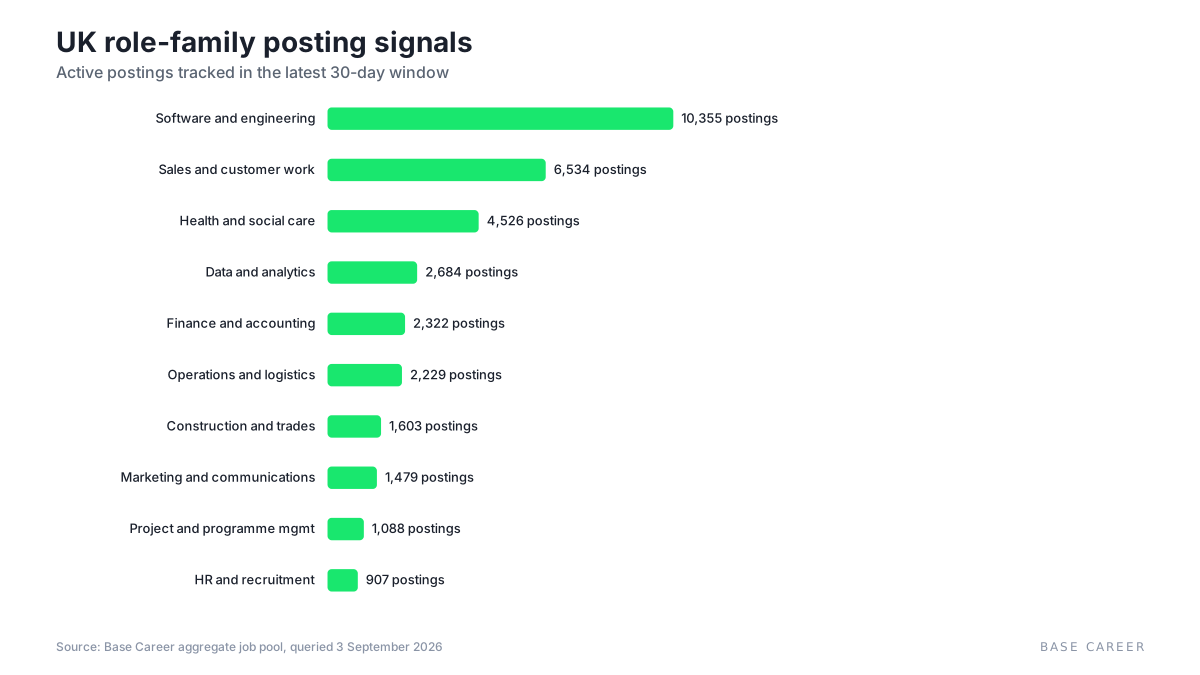
The largest role-family signals
Software and engineering led the grouped sample with 10,355 postings. Sales and customer work followed with 6,534, while health and social care had 4,526. These families are deliberately broad. Software spans different disciplines and levels; customer work includes retail, account and sales language; health and social care includes regulated and non-regulated roles with very different entry conditions.
The next group included data and analytics with 2,684 postings, finance and accounting with 2,322, and operations and logistics with 2,229. Construction and technical trades contributed 1,603, marketing and communications 1,479, project and programme management 1,088, and human resources and recruitment 907. Treat each total as a starting lane for title research, not as a promise that all postings fit the same candidate.
Exact titles tell a more practical story
The most common exact title was Care Assistant with 759 postings, followed by Cleaner with 523, Chef with 371, Retail Assistant with 352 and Assistant Manager with 330. The distance between these exact-title counts and the broader family totals shows why a single saved search can miss relevant work.
Build a controlled title set instead. Start with the title that best describes your recent work, then add adjacent titles only when the responsibilities genuinely overlap. A software candidate might compare developer and engineering labels by speciality. A customer-facing candidate might distinguish retail, account management, business development and customer success rather than sending one generic CV to all of them.
- Choose one primary role family and no more than two adjacent lanes.
- Collect accurate title variants from live vacancies.
- Exclude roles whose essential licence, location or work-right condition you do not meet.
- Map each recurring requirement to evidence you can discuss in an interview.
- Re-check the employer’s own careers page before applying.
London is large, but it is not the whole market
London accounted for 21,431 postings in this snapshot. The next named city totals included Manchester at 1,791, Birmingham at 1,366, Glasgow at 1,296, Bristol at 1,241, Edinburgh at 1,232 and Leeds at 860. Another 13,550 records had no usable city in the aggregate field, so the named-city split should not be read as a complete regional league table.
Location strategy should follow the work, not a city ranking alone. Compare office expectations, commute feasibility, professional networks and the employer’s real workplace policy. A remote label does not automatically mean the role can be performed from any country, and a national posting may still be attached to a specific office, client or travel pattern.
For a deeper city-level method, use Base Career’s data-backed London job-search playbook. This country guide is deliberately broader: it helps you decide which role and region combinations deserve attention before you narrow to one city.
Use the salary field carefully
A usable salary value appeared in 21,924 postings, or 30.4% of the UK sample. That is materially better coverage than a nearly empty field, but it still leaves most tracked records without a usable value. The disclosed subset is also not guaranteed to be representative by occupation, seniority, region, hours or contract type.
Do not turn the mixed pool into a national salary benchmark. Compare compensation within a clearly defined occupation and location, read whether a range is annual or hourly, and check whether the figure is full-time equivalent. For any visa route, use the current official immigration rules rather than assuming that a vacancy’s displayed pay makes it eligible.

“I kept getting rejections from London. Base Career rewrote my CV for Dubai, and I landed Emirates in 3 weeks.”
Sarah M. · Marketing Manager · UK 🇬🇧 → Dubai 🇦🇪
No credit card required
Build a UK Search That Recruiters Can Understand
Start with a live, filtered job pool
Browse current UK jobs on Base Career and filter by the title family that fits your record. Save examples of recurring requirements, but submit through a verified employer channel where possible. The objective is not to copy vacancy language; it is to learn which accurate terms help recruiters recognise your experience.
Create a role-evidence matrix
For each target title, write down the work employers repeatedly ask for and one example that proves you have done it. Good evidence explains the problem, your responsibility, the action you took and what changed. Protect confidential client, patient, customer and commercial information; specificity does not require disclosure of sensitive detail.
Software and data candidates can show reliability, delivery, security, cost or decision-quality outcomes. Sales and customer candidates can distinguish prospecting, service, account growth and retention. Operations candidates can show improvements to quality, throughput, stock, suppliers or risk. Care and health candidates should separate practical experience from any registration or right-to-work requirement.
Tailor the opening third of the CV
The UK National Careers Service CV guidance recommends tailoring a CV to the role and reviewing the job description, essential criteria and company details. Use the opening section to make the target role, relevant evidence and recent experience clear. Do not add keywords you cannot defend, and do not hide dates, employers, qualifications or immigration status behind vague wording.
- Use a headline that names the work you actually do.
- Lead with the most relevant recent evidence, not a generic objective.
- Mirror accurate occupational terminology without copying job-description sentences.
- Keep dates, locations and qualifications consistent across the CV and application form.
- Remove weak detail that pushes stronger evidence out of view.
Treat ATS preparation as clarity work
An applicant tracking system does not reward keyword stuffing. It rewards a document that can be parsed and routed while remaining useful to a human reviewer. Use familiar section names, simple structure and text that explains context. If a vacancy asks for an essential capability, show where you used it and what responsibility you held.
Separate market fit from work permission
If you already have permission to work in the UK, follow the employer’s instructions for proving it. GOV.UK’s right-to-work guidance describes the checks employers must complete and the available online and document-based routes. Use the official service and give accurate information; a CV phrase is not a substitute for the required check.
If you need sponsorship, do not assume a large employer or an advertised vacancy can provide it. The official Skilled Worker visa overview says the route requires an eligible job with an approved UK employer and a certificate of sponsorship, alongside the applicable requirements. The related GOV.UK eligibility page for the job explains that salary rules depend on both the route and the occupation.
Check the official register of licensed worker sponsors, but treat inclusion as one verification step—not evidence that every role is sponsored. Confirm the specific vacancy, employer identity, occupation eligibility and current route rules. Immigration policy can change, so use GOV.UK for the decision that applies to your circumstances.
Check regulated professions separately
Some professions are regulated by law, and recognition can differ across the UK’s nations and authorities. GOV.UK publishes information on regulated professions and their regulators. If your occupation is regulated, identify the responsible regulator before treating a vacancy as actionable.
For overseas qualifications, UK ENIC is the designated national agency for information on international qualifications and skills. An employer or regulator may still have its own evidence requirements. Never claim equivalence, registration or permission until the relevant authority has confirmed it.
Use official labour-market context for the right question
The Office for National Statistics publishes the current UK vacancies and jobs bulletin. It is useful for national trends and survey context. Base Career’s posting pool answers a different question: what active listings appeared in the tracked sources and fields during this run. Do not combine the measures as though they are the same dataset.
A Safer Application Workflow
- Confirm that the vacancy exists on the employer’s official site.
- Check the email domain and recruiter identity independently.
- Read the location, contract, work-right and licence conditions before sharing documents.
- Provide only the information required for the stage you are in.
- Never pay an individual for a guaranteed job, sponsorship or interview.
- Keep a record of the source, employer, role, date and outcome.
Recruitment fraud often relies on urgency and authority signals rather than a credible process. A logo, document or familiar job-board name can be copied. Pause when a recruiter moves immediately to private messaging, asks for money, avoids a verifiable interview or requests sensitive identity material before the employer relationship is clear.
Run a weekly feedback loop
A useful search rhythm separates activity from learning. Review new roles, shortlist against a defined evidence threshold, tailor only the applications that pass, and record outcomes. If applications produce no conversations, inspect targeting and CV clarity. If recruiter calls stall, inspect positioning. If interviews stall, improve examples, role knowledge and questions.
Change one part of the process at a time. Expanding to every title and city after a quiet week destroys the signal you need to improve. A narrower search with honest evidence gives you a better diagnosis—and a stronger application—than a high-volume routine you cannot evaluate.
UK jobs FAQ
Frequently Asked Questions
Which UK role family led Base Career’s latest snapshot?+
Does London have the most opportunities?+
Can Base Career’s salary field be used as a UK salary benchmark?+
Does a company on the sponsor register sponsor every vacancy?+
How should an overseas qualification be checked?+
Sources and method
External sources accessed 3 September 2026: GOV.UK pages for the Skilled Worker route, job eligibility, licensed sponsors, right-to-work checks and regulated professions; National Careers Service CV guidance; the Office for National Statistics vacancies and jobs bulletin; and UK ENIC. Google results fetched the same day surfaced recurring questions about sponsorship, salary thresholds, CV format and rule changes. Those questions informed the structure; unsupported search snippets were not used as evidence.
Base Career aggregate SQL executed 3 September 2026 covered active UK posting totals, exact titles, named cities, salary-field coverage, employment labels and reproducible role-family title grouping. The analysis used no individual job descriptions, users, applications, resumes, customer records or personal data.
Land 4x more interviews in 27 days. Join Base Career Today.
Track applications, tailor resumes, and follow up faster in one UAE job search system.
Start freeNo credit card required

James T.
Canada 🇨🇦 → Riyadh 🇸🇦
“50 applications, zero replies with my Canadian CV. Base Career got me 4 Riyadh interviews and a Series B offer.”
Written by Ankush Wadhwa
Helping you accelerate your career with AI-powered tools.
Related Posts

Is it Easy to Get a Job in Dubai From Overseas? The Honest Truth
Dreaming of a tax-free salary in Dubai but living abroad? We analyze the challenges of international applications and share a strategic roadmap for success.

Landing Your First Dubai Job: A Roadmap for Freshers and Graduates
Breaking into the UAE job market with zero experience is tough but not impossible. Here is your strategic roadmap to landing that first role in Dubai.