Toronto Jobs in 2026: Roles, Search Plan and Work Rights
Ankush Wadhwa

Toronto is large enough to reward focus and crowded enough to punish a generic application strategy. In the latest Base Career snapshot, the city accounted for 8,137 active postings from a Canadian pool of 26,771 postings tracked over the latest 30-day window. That is 30.4% of the observed national pool. The useful question is therefore not whether Toronto has jobs. It is which role family fits your evidence, which employers can hire you, and how you will run a disciplined search.
A Toronto search gets sharper when you choose one role family, prove the matching outcomes, and verify work-right and credential requirements before applying.
What Current Toronto Posting Data Shows
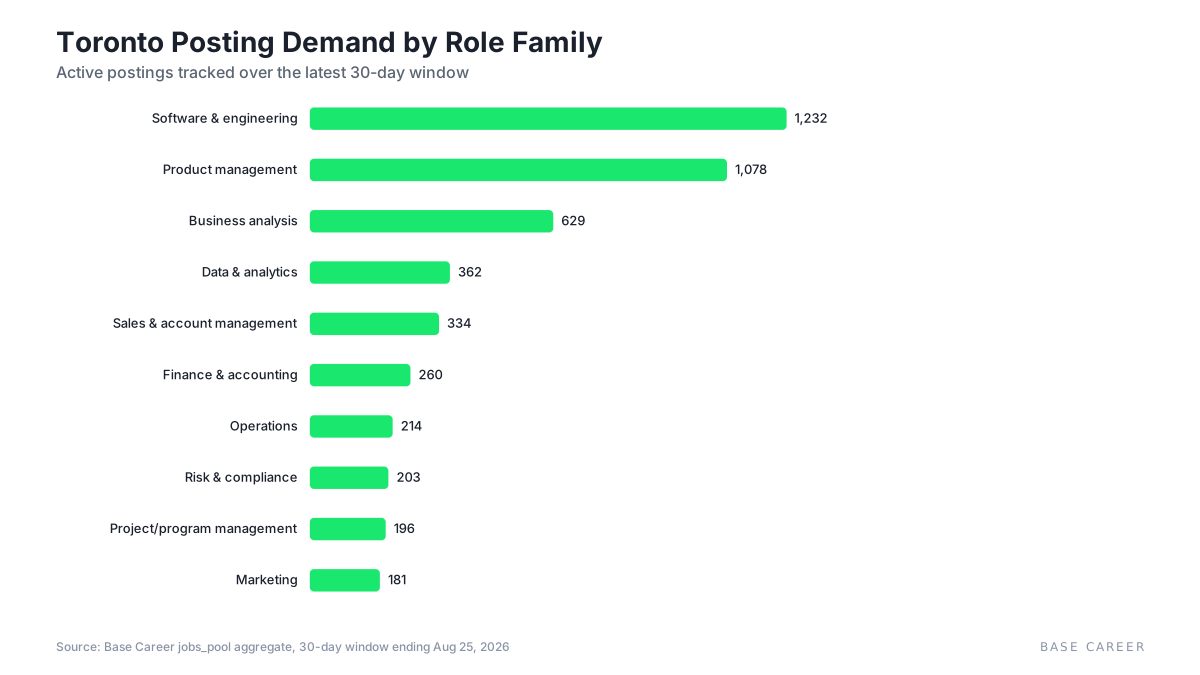
Base Career queried active Canadian postings scraped during the latest 30-day window and matched Toronto using normalized city values. The chart groups job titles into practical role families with a transparent keyword-based method. These are editorial groupings, not official occupational classifications, and each title enters only the first matching family.
The strongest grouped signals were software and engineering with 1,232 postings, product management with 1,078, and business analysis with 629. The next tier included data and analytics at 362, sales and account management at 334, and finance and accounting at 260. These counts describe observed posting volume, not hiring probability or the number of employers.
How To Read The Demand Mix
Volume should help you allocate research time, not tell you to change careers overnight. A broad family can contain several seniority levels and specialties. Product management, for example, includes product manager, product owner, and product strategy titles. Software and engineering includes developer and engineering language. Your shortlist should stay close to work you can prove.
- Use the chart to choose one primary family and one adjacent family.
- Open current Toronto listings and note repeated outcomes, tools, domain language, and seniority signals.
- Remove titles that require experience you cannot demonstrate honestly.
- Build a small employer list before sending applications, rather than searching from zero each day.
The lower-volume grouped families still contain meaningful activity: operations had 214 postings, risk and compliance 203, project and program management 196, and marketing 181. A smaller category can be attractive when your experience is specific and your proof is unusually strong. Fit matters more than chasing the largest bar.
Build A Role-Family Playbook
For software and product work
Translate your experience into shipped outcomes. Show what changed for customers, revenue, reliability, cost, risk, or delivery speed. A product candidate should separate discovery, prioritization, stakeholder alignment, and measured results. An engineering candidate should make architecture, scale, quality, security, or operational ownership clear. Avoid listing every tool you have encountered; select the tools that support the result.
For business analysis and data work
Employers need to see how you moved from an unclear problem to a usable decision. Describe requirements, process mapping, stakeholder groups, data quality, analysis, and the decision or implementation that followed. If a role uses regulated or sensitive data, explain governance experience without exposing confidential information.
For finance, risk, sales, and operations
Use evidence that fits the function. Finance and risk candidates can show controls improved, reporting accelerated, exposure reduced, or audits supported. Sales candidates can show territory, deal complexity, retention, or pipeline outcomes without naming private customers. Operations candidates can show throughput, quality, service levels, cost, or incident reduction. Keep every claim defensible in an interview.
Employment Type And Salary Data Need Context

“I kept getting rejections from London. Base Career rewrote my CV for Dubai, and I landed Emirates in 3 weeks.”
Sarah M. · Marketing Manager · UK 🇬🇧 → Dubai 🇦🇪
No credit card required
Employment-type labels in the source data are messy, so Base Career normalized exact variants for this analysis. The result was 5,293 full-time-labelled postings, equal to 65.0% of the Toronto sample. Another 2,253 postings, or 27.7%, did not specify an employment type. Exact contract labels accounted for 323 postings, while exact part-time labels accounted for 174. Mixed and uncommon labels remain outside those simplified totals.
- Treat an unspecified label as missing data, not evidence that the role is permanent.
- Confirm employment status, hours, location expectations, and contract length with the employer.
- Do not infer benefits or eligibility from the title alone.
- Record the wording used in the original posting so you can ask precise questions.
Salary coverage is too thin for a responsible Toronto pay benchmark in this dataset. Only 374 of 26,771 Canadian postings had a non-empty salary field, a coverage rate of 1.4%. Use employer ranges, official labour-market tools, and credible compensation sources for pay research. Do not treat an absent salary as a low offer, and do not build a market-wide salary claim from this pool.
A Focused Toronto Job-Search Plan
Start with current Toronto job listings on Base Career, then validate roles on employer career sites. The queue evidence behind this article found a large Toronto pool but no dedicated Toronto city-page pattern on Base Career, so this guide addresses the city-specific intent without pretending a missing landing page already exists.
- Choose one primary role family from the current demand mix.
- Write a one-sentence positioning statement that names the problems you solve and the evidence you bring.
- Create a target list of employers whose domain and role level match your background.
- Save two or three title variations, because employers use different labels for similar work.
- Tailor the top third of your resume to the role outcome, then adjust supporting bullets only where the evidence is real.
- Track applications, responses, interviews, and rejection themes so you can improve the process without guessing.
Make Your Resume Easy To Validate
A strong Toronto resume does not need inflated language. It needs a clear target, readable chronology, relevant skills, and outcome-led bullets. Use the same vocabulary as the job when it accurately describes your work. Keep acronyms understandable. If your employer or qualification is unfamiliar in Canada, add a short clarifier rather than a long biography.
- Lead each recent role with scope and the most relevant result.
- Use numbers only when you can explain how they were measured.
- Keep regulated credentials separate from general training.
- Do not claim Canadian work authorization unless it is current and accurate.
- Remove personal details that the employer did not request.
Check Work Rights Before You Apply
The Government of Canada work-permit hub distinguishes employer-specific permits, which require a job offer, from open work permits, which do not require one. It also directs applicants to special instructions and eligibility tools. Your route depends on your circumstances, so confirm the official requirements rather than relying on a recruiter, forum, or old checklist.
For candidates outside Canada, the official Job Bank foreign-candidate guide says to confirm eligibility, check whether qualifications are recognized, and search jobs from employers recruiting international candidates. That order matters. It prevents you from presenting an uncertain status as settled and helps you focus on employers using the appropriate recruitment route.
Check Whether Your Occupation Is Regulated
Ontario explains that a regulated profession or trade may require a licence or certificate and registration with the relevant body. Use the province's profession and trade guidance to identify the regulator and requirements. Do this early for occupations where a protected title or restricted practice applies. For non-regulated work, a professional association may still be useful, but membership is not automatically a legal requirement.
Verify Employers And Recruiters
Job seekers are attractive targets because urgency can override caution. The Canadian Anti-Fraud Centre's job-fraud guidance warns about unsolicited offers, fake tasks, deposits, money forwarding, and requests to install unknown software. Verify the employer through its official domain and contact details before sharing sensitive documents.
- Do not pay a deposit, upgrade fee, or unlock payment to get work.
- Do not receive and forward money through your personal account.
- Do not install unknown recruitment software from an unverified contact.
- Compare the sender's domain with the employer's official website.
- Pause when an offer arrives without a credible application and interview trail.
Know The Employment-Standards Baseline
Ontario's Employment Standards Act guide covers areas such as wages, hours, termination, public holidays, leave, vacation, and recruiter or temporary-help rules. The province notes that the guide is informational rather than legal advice. Use it to prepare questions and follow the current law or professional advice when your situation is complex.
Use Toronto's Sector Map For Employer Research
The City of Toronto's industry-sector support page provides official starting points for sectors including technology, financial services, life sciences, creative industries, food and beverage, green industries, and the visitor economy. Use those sector pages to identify ecosystems, associations, and employer types. Then return to your role family and ask where your evidence transfers best.
A Practical Weekly Operating Rhythm
- Research employers and refresh your shortlist at the start of the week.
- Submit fewer, better-matched applications with verified requirements.
- Contact relevant people with a specific, low-pressure question rather than asking strangers for a job.
- Prepare one interview story for each important capability in your target role.
- Review your funnel at week's end and change one variable at a time.
If applications produce no conversations, inspect targeting and resume clarity. If conversations stall before interviews, inspect positioning and evidence. If interviews stall, improve examples, role knowledge, and questions. A measured search helps you diagnose the stage instead of rewriting everything after each rejection.
Toronto Jobs FAQ
Frequently Asked Questions
Which role families had the most Toronto postings in this snapshot?+
Does a large posting count mean the role is easy to get?+
Can I apply to Toronto jobs from outside Canada?+
Should I trust salary figures from Base Career's Canadian posting pool?+
How can I avoid Toronto job scams?+
Sources And Method
- Base Career jobs_pool aggregate queries executed August 25, 2026: Canadian coverage, Toronto city filter, role-family title grouping, employment-type normalization, and salary-field coverage.
- Government of Canada, Work in Canada temporarily — accessed August 25, 2026.
- Government of Canada Job Bank, Foreign candidates from outside Canada — accessed August 25, 2026.
- Government of Ontario, Work in your profession or trade — accessed August 25, 2026.
- Government of Ontario, Your guide to the Employment Standards Act — accessed August 25, 2026.
- Canadian Anti-Fraud Centre, Job fraud — accessed August 25, 2026.
- City of Toronto, Industry Sector Support — accessed August 25, 2026.
This article uses aggregate posting data and public sources only. It does not use individual job descriptions, applicants, resumes, or customer records. For broader national context, read Canada Job Search in 2026: Roles, Cities and Permits. Always verify current requirements with the responsible authority and the employer.
Land 4x more interviews in 27 days. Join Base Career Today.
Track applications, tailor resumes, and follow up faster in one UAE job search system.
Start freeNo credit card required

James T.
Canada 🇨🇦 → Riyadh 🇸🇦
“50 applications, zero replies with my Canadian CV. Base Career got me 4 Riyadh interviews and a Series B offer.”
Written by Ankush Wadhwa
Helping you accelerate your career with AI-powered tools.
Related Posts

Is it Easy to Get a Job in Dubai From Overseas? The Honest Truth
Dreaming of a tax-free salary in Dubai but living abroad? We analyze the challenges of international applications and share a strategic roadmap for success.

Landing Your First Dubai Job: A Roadmap for Freshers and Graduates
Breaking into the UAE job market with zero experience is tough but not impossible. Here is your strategic roadmap to landing that first role in Dubai.