Are Online Degrees Respected in Dubai? How to Protect Your Career
.png)
Ankush Wadhwa

The global education landscape has fundamentally shifted. Over the past few years, pursuing an online degree from a prestigious Western institution has become a highly popular route for ambitious professionals. For expatriates looking to advance their careers in the Middle East without stepping away from the workforce, a distance-learning Master's or MBA seems like the perfect solution. But if you are targeting competitive corporate roles in the UAE, a critical question remains: are online degrees respected in Dubai, or can distance learning stifle your growth?
The UAE job market presents a unique paradox. On one hand, Dubai is a hyper-modern, digital-first business hub that embraces innovation, artificial intelligence, and remote work. On the other hand, the region's hiring infrastructure, corporate governance, and visa regulations are still heavily rooted in traditional credentialing. The Middle East places immense value on pedigree, institutional reputation, and verified qualifications. When these two realities collide, professionals holding online or hybrid degrees often find themselves facing a strategic dilemma.
If you are an expatriate planning to leverage a distance-learning credential to break into a senior management role, secure a higher salary band, or obtain a Golden Visa, understanding the nuances of UAE degree recognition is non-negotiable. Misunderstanding how employers and government ministries view online qualifications can lead to rejected visa applications, stalled promotions, and lost job offers. This comprehensive guide will analyze the exact career risks associated with online degrees in the UAE, explore the regulatory landscape of degree attestation, and provide actionable strategies to ensure your distance-learning credentials elevate your career rather than hold it back.
The Regulatory Reality: MOFA, MOE, and Degree Equivalency
To understand the debate surrounding online degrees in the UAE, you first have to separate employer preference from legal regulation. In the UAE, securing a white-collar employment visa requires your educational certificates to be authenticated by the government. This is a multi-step process that ultimately requires a stamp from the UAE Ministry of Foreign Affairs (MOFA). Furthermore, for specific regulated professions or for government roles, you may also need a Certificate of Equivalency from the UAE Ministry of Education (MOE).
Historically, the UAE maintained a strict stance against distance learning. Degrees earned fully online were frequently rejected for equivalency, creating significant hurdles for professionals holding legitimate online degrees from accredited global universities. However, the regulatory landscape has recently evolved. Recognizing the post-pandemic shift in global education, the UAE MOE updated its guidelines to recognize distance-learning degrees—but with stringent conditions attached.
Today, an online degree can be officially recognized in the UAE, provided the issuing institution is fully accredited in its home country and the specific online program meets the same academic standards as its traditional, on-campus counterpart. The MOE scrutinizes the university's global ranking, the accreditation of the distance-learning module, and the total credit hours. If you enrolled in an unaccredited "diploma mill" or an online program that significantly shortcuts the standard academic curriculum, your degree will not pass the equivalency check. The reality is that advanced degrees won't guarantee UAE job offers if they fail to meet the strict credentialing standards established by local authorities.
For expats, the distinction between a MOFA attestation and MOE equivalency is vital. If you are joining a private company in a standard commercial role (like marketing, sales, or HR), you usually only need a MOFA attestation. MOFA verifies that the document is genuine, a process that online degrees from reputable universities typically pass without issue. However, if you are an engineer, doctor, academic, or entering a government role, you need MOE equivalency, which involves a much deeper academic audit of how the degree was delivered.
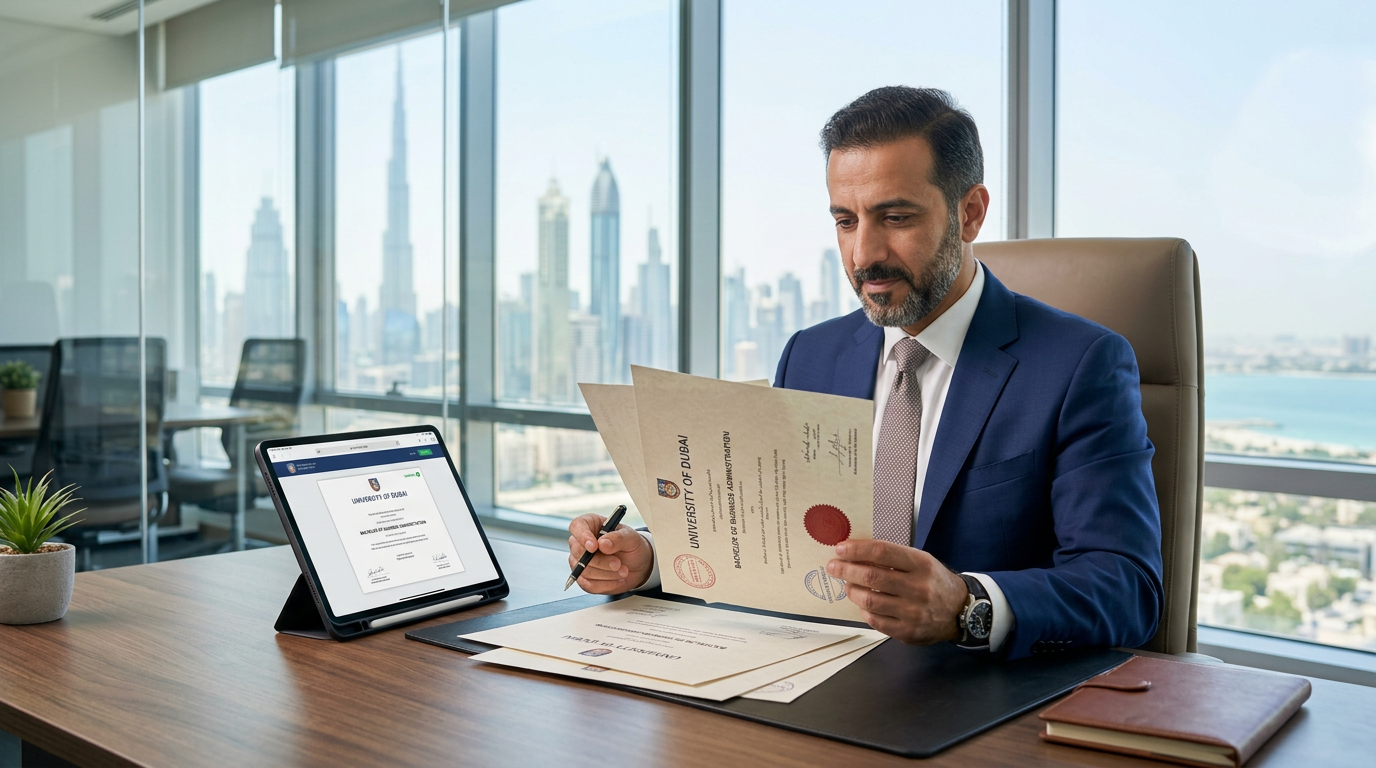
Do UAE Employers Actually Discard Resumes with Online Degrees?
Beyond the legal visa requirements, the real battleground for distance-learning credentials is the corporate hiring market. Do recruiters and hiring managers in Dubai view an online Master's degree differently than an on-campus one? The answer largely depends on the sector you are applying to, the reputation of the university, and the seniority of the role you are targeting.
In the private sector—particularly within multinational corporations (MNCs) based in free zones like DIFC, Dubai Internet City, or DMCC—the stigma surrounding online degrees has largely vanished. Tech companies, global consultancies, and modern financial institutions care far more about your practical capabilities, project portfolio, and track record of delivering results than whether you sat in a physical lecture hall. If you earned an online MBA from a highly ranked institution like the University of Illinois or Imperial College London, these employers view it as a testament to your time management, self-motivation, and commitment to continuous learning.
Conversely, the local conglomerate and semi-government sectors tend to lean more traditional. Hiring managers in these organizations often hold a conservative view of education, sometimes equating distance learning with a lack of rigor. In highly competitive candidate pools where dozens of applicants hold traditional degrees from Ivy League or Russell Group universities, an online degree might be quietly viewed as a secondary qualification. This bias is rarely stated explicitly in job descriptions, but it can occasionally manifest during executive screening processes where 'pedigree' is used as a tie-breaker between top candidates.
This is precisely why career positioning outperforms degrees in the UAE. An employer might initially question the format of your education, but if your resume clearly articulates how you drove multi-million-dollar revenue growth, led cross-functional teams across the GCC, or spearheaded digital transformation initiatives, the "online" nature of your degree quickly becomes irrelevant. Competence, when clearly communicated, effectively neutralizes credential bias.
ATS Scanners and Online Degrees: The Invisible Filter
A major concern for job seekers is how Applicant Tracking Systems (ATS) handle online degrees. In the UAE, over 75% of medium to large enterprises utilize ATS software to screen the thousands of applications they receive for a single job posting. Candidates often worry that if their degree is tagged as "online," the ATS will automatically reject their application.
Fortunately, this is a misconception. ATS software is programmed to parse data based on specific keywords related to the job description—primarily skills, job titles, and the level of education required (e.g., "Bachelor's Degree" or "MBA"). The software does not inherently distinguish between an online degree and an on-campus degree unless the recruiter specifically configures a knockout question asking, "Did you complete this degree on-campus?"—a practice that is virtually non-existent in the modern UAE job market.

“I kept getting rejections from London. Base Career rewrote my CV for Dubai, and I landed Emirates in 3 weeks.”
Sarah M. · Marketing Manager · UK 🇬🇧 → Dubai 🇦🇪
No credit card required
The real ATS challenge isn't the format of your degree, but ensuring your educational qualifications are formatted cleanly so the system can read them. If your resume features complex graphics, hidden tables, or unusual terminology trying to explain the hybrid nature of your degree, the ATS might fail to parse your education section entirely. This will result in an automatic rejection, not because your degree was online, but because the system couldn't verify that you held a degree at all.
In the UAE job market, an online MBA from a tier-one global university will almost always outrank a traditional on-campus degree from a virtually unknown institution. Pedigree scales beyond the delivery method.
How to Position Distance Learning on Your UAE Resume
If you hold a distance-learning degree, how you present it on your resume is a vital strategic decision. Transparency is important, but over-explaining the delivery method of your education can unnecessarily invite bias. The general rule of thumb for the UAE market is to present your degree exactly as it appears on your official diploma and transcripts.
- Do not explicitly label it as "Online" unless the university requires it: Most top-tier universities (like the University of London or Penn State) issue degrees that are identical to their on-campus counterparts. If your diploma says "Master of Science in Marketing," write exactly that on your CV. Adding "(Online)" offers no strategic advantage and may trigger traditional biases.
- Focus on the institution's prestige: If your online degree is from a highly respected university, lead with the institution's name. The brand equity of a globally recognized university carries significant weight in Dubai's expat-heavy corporate environment.
- Highlight relevant coursework and capstones: To demonstrate the rigor of your program, include a brief bullet point detailing a major research project, thesis, or practical capstone you completed, especially if it relates directly to the UAE market or the specific role you are applying for.
- Include it alongside professional experience: If you completed your degree while working full-time in the UAE, list the dates concurrently. This implicitly shows hiring managers that you were working and studying simultaneously, which is highly respected and demonstrates exceptional time management.
If you find that despite having a strong degree, you are still not securing interviews, the issue is likely broader than the degree's format. If you are concerned about this, performing a career positioning audit can help identify misalignments between how you present your experience and what UAE employers actually value.

When an Online Degree Actually Adds Value in Dubai
While much of the conversation revolves around mitigating the risks of an online degree, there are distinct scenarios where distance learning acts as a significant career accelerator in the UAE. Employers deeply value practical application. When an online degree is strategically paired with ongoing professional experience, it can elevate your profile above candidates who took a traditional career break to study.
The "Executive Advantage" is a prime example. If you are a mid-level manager in Dubai pursuing an online Executive MBA (EMBA), you are directly applying the theories you learn on the weekend to your corporate role on Monday. During interviews, this becomes a powerful narrative. You aren't just presenting theoretical knowledge; you are presenting proven, real-world implementations of modern business strategies. UAE hiring managers look favorably upon candidates who invest in their own upskilling while actively contributing to the local economy.
Furthermore, in rapidly evolving sectors like Artificial Intelligence, Data Science, Cybersecurity, and Digital Transformation, online degrees and micro-credentials from elite platforms (partnered with universities like MIT or Stanford) are highly prized. The UAE is aggressively pursuing a digital-first future, driven by initiatives like the Dubai Economic Agenda (D33). The technology sector moves too fast for traditional academia to keep up. In these fields, a recent, specialized online degree is often viewed as more relevant and up-to-date than a traditional degree earned a decade ago.
The Impact on Senior Executive Roles and Relocations
For expats looking to secure C-suite or Director-level roles, the scrutiny placed on credentials intensifies. At the executive level, board members and executive search firms (headhunters) conduct deep due diligence on potential candidates. The primary concern at this stage is not necessarily the online nature of the degree, but rather the overall executive presence, leadership track record, and market authority the candidate possesses.
If your foundational Bachelor's degree is from an unknown institution, and your only advanced qualification is an unranked online MBA, headhunters may struggle to justify your candidacy to a demanding local board. However, if you have a solid undergraduate background, ten years of progressive leadership experience in the GCC, and an online Master's from a recognized university to cap it off, your profile is highly competitive.
For senior candidates, the degree is merely a baseline requirement. What truly differentiates an executive is their ability to navigate complex UAE market dynamics, negotiate high-level deals, and lead diverse cultural teams. Before accepting a leadership position, you must also know how to audit an executive job offer in Dubai to ensure that your compensation aligns with the premium value your combined education and experience bring to the table.
Strategic Alternatives to Bridge the "Degree Gap"
If you fear that your online degree is not providing the heavy-lifting required to open doors in the UAE, you must shift your focus toward alternative authority-building strategies. In the Middle East, personal branding, professional networking, and demonstrable market impact can bridge almost any credential gap.
1. Build a Hyper-Targeted LinkedIn Presence: UAE recruiters rely heavily on LinkedIn. Optimize your profile to highlight your functional expertise, leadership outcomes, and specific knowledge of the GCC market. Share insights on local industry trends. When your profile exudes authority, recruiters are less likely to dissect the format of your university education.
2. Pursue Globally Recognized Industry Certifications: In many fields, specialized certifications carry as much, if not more, weight than a Master's degree. Certifications like the PMP (Project Management), CFA (Finance), CIPD (Human Resources), or CISSP (Cybersecurity) are universally respected in the UAE and provide immediate validation of your technical competence, offsetting any doubts a traditional employer might have about distance learning.
3. Cultivate "Wasta" Through Professional Networking: In the Middle East, "Wasta" (connections/influence) plays a pivotal role in executive hiring. Attend industry conferences at the Dubai World Trade Centre, join local professional syndicates, and build genuine relationships with decision-makers. A strong personal recommendation from a respected industry figure completely supersedes any academic credential checks during the initial interview phase.

Frequently Asked Questions
Are online degrees accepted for UAE employment visas?+
Do I need to mention my degree was online on my UAE resume?+
Can an online MBA help me secure a Golden Visa in Dubai?+
Do UAE employers treat online and on-campus degrees the same?+
Conclusion: Protect Your Career by Perfecting Your Pitch
An online degree is an excellent tool for professional growth, and the UAE market is increasingly recognizing the value of distance learning. Whether your degree accelerates your career or stifles it ultimately comes down to how you position it. If you present your qualifications with confidence, back them up with localized market experience, and target the right employers, an online degree will not block your path to senior leadership in Dubai.
However, the most crucial element of your job search isn't just having the credential—it is ensuring that your entire application package effectively communicates your value to the employer's ATS and the hiring manager. If your resume fails to highlight your strategic impact, even the best Ivy League degree won't save you from the rejection pile.
Tools like Base Career automatically tailor your resume for each application—generating an ATS-optimised CV matched to the specific job description in under a minute. By combining Base Career's Resume Health Score with its smart Job Matching features, you can ensure your experience outshines any credentialing doubts and lands you directly in front of UAE decision-makers. Don't let a poorly formatted resume hide your hard-earned qualifications. Try it free at https://app.basecareer.co/auth.
Stay ahead of the market. Join Base Career Today.
Turn market shifts into a clearer application workflow with resume tailoring and tracking in one place.
Start freeNo credit card required

James T.
Canada 🇨🇦 → Riyadh 🇸🇦
“50 applications, zero replies with my Canadian CV. Base Career got me 4 Riyadh interviews and a Series B offer.”
Written by Ankush Wadhwa
Helping you accelerate your career with AI-powered tools.
Related Posts

Landing Your First Dubai Job: A Roadmap for Freshers and Graduates
Breaking into the UAE job market with zero experience is tough but not impossible. Here is your strategic roadmap to landing that first role in Dubai.

Building 'Wasta' from Scratch: Networking Strategies for Dubai Expats
Frustrated by 1,000+ applicants on LinkedIn? Learn how to build 'Wasta'—your professional network—from zero to access the UAE's hidden job market.