New York City Jobs: Where Demand Is Strong in 2026
Ankush Wadhwa

New York City rewards focus more than volume. Base Career tracked 4,165 active New York City postings inside a wider pool of 107,729 active US postings scraped during the latest 30-day window. That city sample represented 3.9% of the observed US pool. The practical question is not whether New York has openings. It is which role family fits your evidence, which channel matches the employer, and how you will run a search that stays measurable.
A New York City job search becomes easier to manage when you choose a role family, build a small employer map, and treat every application as a test of fit rather than a lottery ticket.
What Current New York City Posting Data Shows
This analysis uses aggregate rows only. Base Career filtered active US postings scraped in the latest 30-day window, then combined records whose normalized city was New York or New York City. Role families were assigned with a reproducible title-keyword hierarchy. A title enters the first matching family, so the chart is directional rather than an official occupational classification.
The city field is not complete across the wider US pool, and the same occupation may appear under several title variants. The counts therefore describe what Base Career observed, not the total size of New York employment, the number of employers, or a candidate's probability of being hired.
The Strongest Role-Family Signals
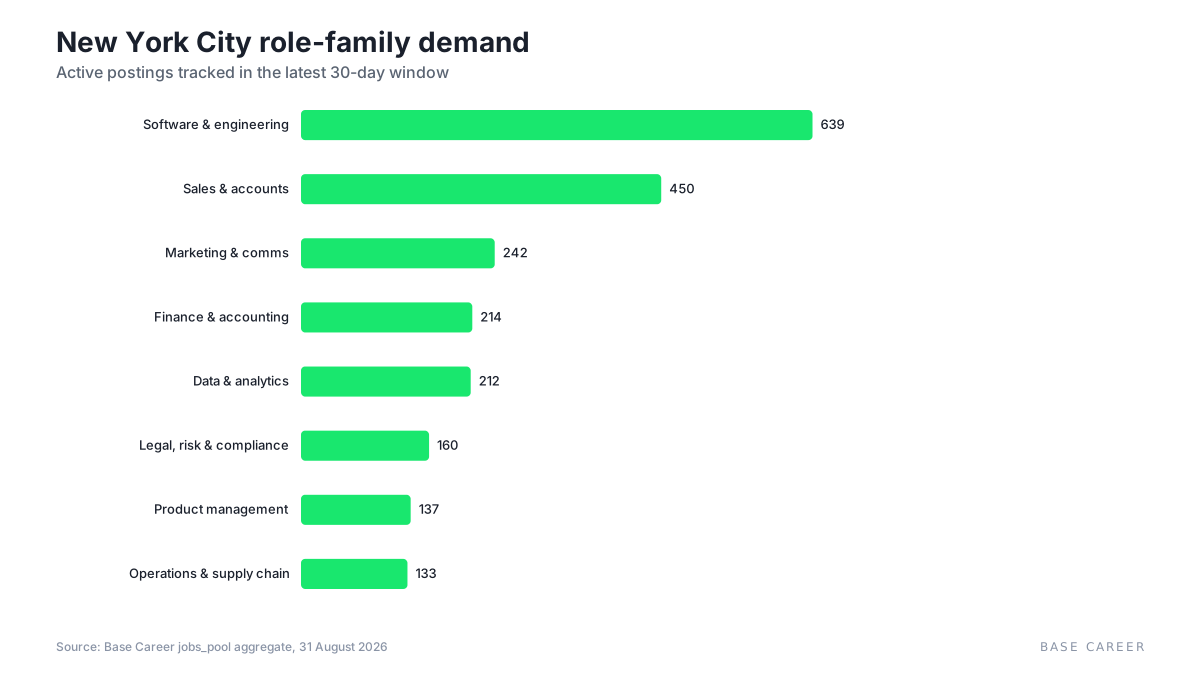
Software and engineering led with 639 postings, followed by sales and account management with 450. The gap matters, but it should not push a candidate into a field they cannot support with real experience. A larger family can also contain many specializations, seniority levels, work arrangements, and employer types.
- Software and engineering includes developer, engineering, cloud, DevOps, and related title language.
- Sales and account management includes account executive, business development, customer success, and closely related titles.
- Use the family as a research lane, then narrow to the job outcomes and seniority you can prove.
- Do not treat the size of a bar as evidence that sponsorship, remote work, or entry-level access is widely available.
The next group was broad rather than concentrated: marketing and communications had 242 postings, finance and accounting 214, and data and analytics 212. Base Career also grouped 160 legal, risk, and compliance postings, 137 product management postings, and 133 operations and supply-chain postings. These are useful lanes for employer research because each rewards different proof.
Exact Titles Reveal Fragmentation
Exact-title counts were much smaller than family totals. Account Executive appeared in 19 postings; Executive Assistant and Sales Development Representative each appeared in 18; Business Development Representative appeared in 12; and Project Manager appeared in 11. This fragmentation is a reason to save related title variants instead of searching a single phrase.
- Choose one primary title and several accurate alternatives.
- Separate seniority words from the core function when building alerts.
- Search employer career sites as well as aggregators because titles are not standardized.
- Read the responsibilities before deciding that two similar titles represent the same work.
Employment Labels And Salary Fields Need Caution
After normalizing common full-time label variants, 2,505 postings, or 60.1% of the New York City sample, were marked full time. That is a data-label observation, not a guarantee about hours, benefits, permanency, location expectations, or employee classification.
Another 1,405 postings, equal to 33.7% of the city sample, did not specify an employment type. Treat unspecified as missing information. Ask the employer about schedule, location, classification, contract length, and benefits instead of filling the gap with an assumption.
Salary data was present in 1,244 of the 4,165 New York City postings tracked by Base Career, a field-coverage rate of 29.9%. That is not enough for a responsible citywide pay benchmark because reporting is uneven across employers, occupations, and seniority. Use the range in the actual posting, official labor-market tools, and role-specific compensation research rather than averaging this mixed pool.
Build A Three-Lane New York Search
Private-sector openings
Start with current New York listings on Base Career, then verify promising openings on the employer's own career site. Keep a short target list organized by role family, industry, and evidence of fit. A focused list makes it easier to notice repeated requirements and reduces the temptation to apply indiscriminately.
City and public-sector careers

“I kept getting rejections from London. Base Career rewrote my CV for Dubai, and I landed Emirates in 3 weeks.”
Sarah M. · Marketing Manager · UK 🇬🇧 → Dubai 🇦🇪
No credit card required
Use the official NYC Government Jobs portal for city careers and the broader Jobs NYC employment hub for jobs, training, and career resources. Public-sector hiring can use different job families, eligibility rules, examinations, and timelines from private employers, so read the official posting and process rather than transferring assumptions from a corporate application.
No-cost career support
The NYC Department of Small Business Services says its Virtual Workforce1 Career Center can help people identify fitting jobs, prepare for interviews, and access training at no cost. The New York State Department of Labor job-search hub also links to the state job bank, resume guidance, networking help, and career-development services.
If you prefer local support, the state also maintains an official Career Center directory. Use these services to pressure-test your target and application materials. They should complement direct employer research, not replace it.
Match Your Evidence To The Role Family
Software, engineering, and product
Lead with shipped outcomes. Explain what changed for users, reliability, security, revenue, cost, or delivery speed. Engineers should make ownership and technical constraints clear. Product candidates should separate discovery, prioritization, stakeholder alignment, and measured outcomes. A tools list without context is weaker than a concise example showing what you built and why it mattered.
Sales and account management
Show the motion you understand: prospecting, enterprise sales, renewals, partnerships, customer success, or account growth. Describe territory, deal complexity, sales cycle, retention, or pipeline outcomes without exposing confidential customer information. Match your examples to the employer's customer and route to market rather than repeating generic sales language.
Marketing, finance, data, and risk
Marketing candidates can connect campaigns to qualified demand, adoption, or retention. Finance candidates can show faster reporting, better controls, accurate forecasting, or improved decision support. Data candidates should explain the business question, data quality, method, and decision that followed. Risk and compliance candidates should describe controls, governance, or remediation while protecting sensitive details.
- Keep one primary role family and one adjacent family.
- Create a proof bank with short examples for the capabilities that repeat across postings.
- Remove roles whose required scope or credentials you cannot support honestly.
- Use the employer's vocabulary only when it accurately describes your experience.
- Tailor the opening summary and strongest bullets before changing the rest of the resume.
Make Your Resume Easy To Validate
Recruiters need to understand your target quickly. Use a clear headline, readable chronology, relevant skills, and outcome-led bullets. If an employer, degree, or credential is unfamiliar in the United States, add a short factual clarifier. Do not bury the strongest evidence below a long profile or an undifferentiated skills inventory.
- Name the problem, your action, and the result in each important example.
- Use numbers only when you can explain how they were measured.
- Keep confidential customer, revenue, and system details out of the document.
- Separate regulated credentials from general training.
- Check dates, titles, locations, links, and formatting before every submission.
Applicant tracking systems do not reward keyword dumping. They reward readable evidence that matches the role. Use exact terms from the posting when they are true, include common title variants where useful, and keep formatting simple enough to parse. Then prepare to explain every claim in an interview.
Use Pay Transparency Without Overreading It
The New York State Department of Labor pay-transparency page explains the state's requirement for covered advertised jobs, promotions, and transfers to include a compensation range. Treat the posted range as a starting boundary, not a promise about where an offer will land. Role scope, location, experience, internal equity, incentives, and benefits still need to be clarified.
Before discussing compensation, record the posted range, whether it covers base pay or broader compensation, and the responsibilities attached to it. Ask specific questions about variable pay, equity, benefits, work location, schedule, and review timing. A strong negotiation is grounded in the role and your evidence, not a generic citywide average.
Be Precise About Work Authorization
The official USCIS I-9 Central states that employers hiring someone for employment in the United States must complete Form I-9 to verify identity and employment authorization. Your individual path depends on your status and circumstances. Do not imply authorization you do not have, and do not assume that a role provides sponsorship unless the employer confirms it through a legitimate process.
- Describe your current authorization accurately when an application asks.
- Keep sponsorship questions separate from your proof of fit.
- Use official federal guidance or qualified professional advice for status-specific questions.
- Do not send identity documents to an unverified contact or personal email address.
Protect Yourself From Job Scams
The Federal Trade Commission's job-scam guidance warns that scammers advertise through many of the same channels as legitimate employers and may be after money or personal information. Verify the employer's domain, career page, recruiter identity, and interview trail before sharing sensitive material.
- Do not pay to unlock a job, equipment payment, training payment, or government application.
- Do not deposit a check and send money back or buy gift cards for an employer.
- Do not receive and forward packages or payments as a condition of work.
- Compare the sender's email domain with the employer's official website.
- Pause when an offer arrives without a credible application and interview process.
A Practical Weekly Operating Rhythm
- Refresh your employer shortlist and saved title variants.
- Review new postings and select only the roles that meet your evidence threshold.
- Tailor the strongest section of your resume and submit through a verified channel.
- Prepare one interview story for each capability that repeats across target postings.
- Track applications, responses, interviews, and rejection themes, then adjust one variable at a time.
If applications produce no conversations, inspect targeting and resume clarity. If recruiter calls do not become interviews, inspect positioning and evidence. If interviews stall, improve your examples, role knowledge, and questions. A measured process makes the problem visible and prevents a complete rewrite after every rejection.
New York City Jobs FAQ
Frequently Asked Questions
Which role family had the most New York City postings in this snapshot?+
Does a larger posting family mean it is easier to get hired?+
Where should I look for New York City government jobs?+
Can I use the Base Career sample as a New York salary benchmark?+
How do I avoid New York job scams?+
Sources And Method
External sources accessed August 31, 2026: NYC Government Jobs; Jobs NYC; Virtual Workforce1; New York State Department of Labor Find a Job; New York State Career Centers; New York pay transparency; USCIS I-9 Central; and FTC Job Scams.
Base Career aggregate queries executed August 31, 2026 covered active US and New York City posting totals, role-family title grouping, exact-title counts, normalized employment-type coverage, and salary-field coverage. The analysis used no individual job descriptions, applicant records, resumes, users, or customer content.
For national context, read How to Get Hired in the USA in 2026. Always verify the current posting, employer process, legal requirements, and official guidance for your circumstances.
Land 4x more interviews in 27 days. Join Base Career Today.
Track applications, tailor resumes, and follow up faster in one UAE job search system.
Start freeNo credit card required

James T.
Canada 🇨🇦 → Riyadh 🇸🇦
“50 applications, zero replies with my Canadian CV. Base Career got me 4 Riyadh interviews and a Series B offer.”
Written by Ankush Wadhwa
Helping you accelerate your career with AI-powered tools.
Related Posts

Is it Easy to Get a Job in Dubai From Overseas? The Honest Truth
Dreaming of a tax-free salary in Dubai but living abroad? We analyze the challenges of international applications and share a strategic roadmap for success.

Landing Your First Dubai Job: A Roadmap for Freshers and Graduates
Breaking into the UAE job market with zero experience is tough but not impossible. Here is your strategic roadmap to landing that first role in Dubai.