India Tech Jobs in 2026: Roles, Cities and Skills
Ankush Wadhwa

India’s technology job market is large, but a broad search can still produce weak results. The practical problem is not finding listings; it is deciding which role family, city and evidence of skill deserve your attention. Base Career tracked 18,231 active India postings scraped in the trailing 30 days on 10 August 2026. Within that pool, software and data roles repeatedly appeared near the top, while Bengaluru accounted for the largest city-labelled share by a wide margin.
This guide turns that aggregate snapshot into a job-search plan. It explains where tracked demand is concentrated, how to choose a role lane, how to write an ATS-readable CV, and how to test your search rather than sending the same application everywhere. The figures describe the postings Base Career could observe; they are not a census of every vacancy in India, and source coverage, duplicate handling and missing fields can affect the shape of the sample.
A focused search is easier to improve: one role family, a small city set, clear proof of skills and a weekly review of results.
What Base Career’s current India snapshot shows
The aggregate role query found 291 Senior Software Engineer postings, 218 Software Engineer postings and 128 Data Engineer postings. Principal Software Engineer followed with 94, Senior Data Engineer with 86, Lead Software Engineer with 84 and Staff Software Engineer with 73. Data Scientist appeared 61 times, while DevOps Engineer and Senior DevOps Engineer each appeared 51 times.
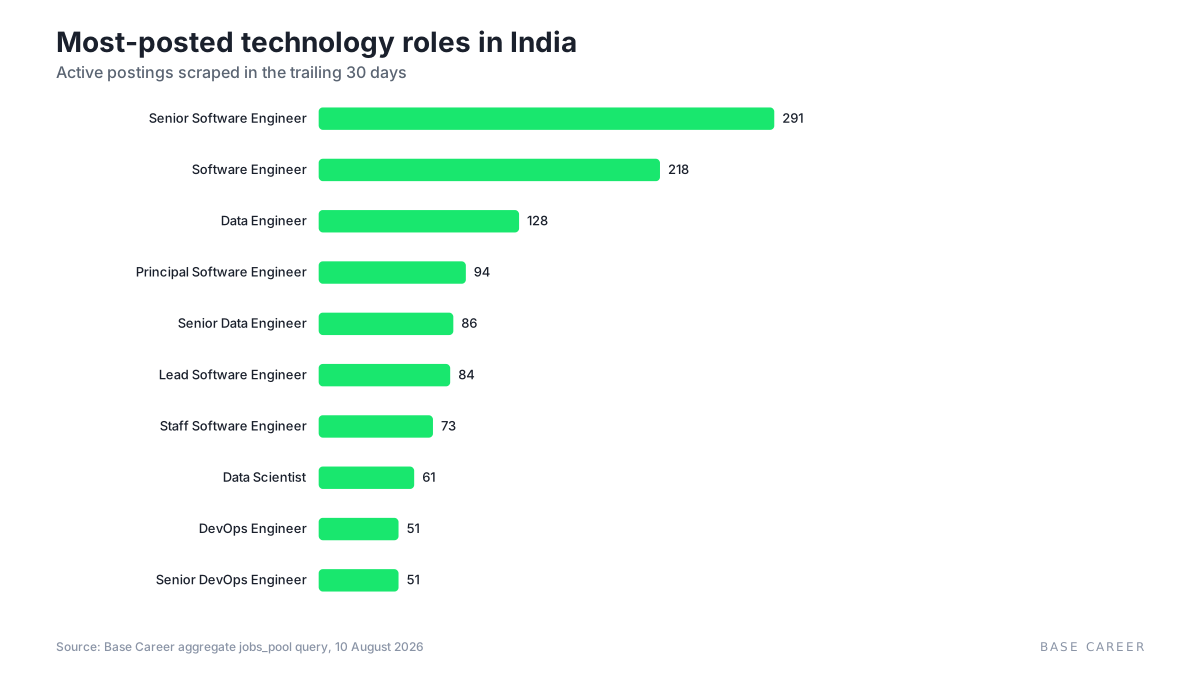
The pattern does not mean every engineering candidate should apply to senior roles. It means employers in the tracked pool often described demand through established engineering ladders. Your search terms should therefore reflect your actual scope. If you have owned architecture, mentoring and cross-team delivery, senior or lead terms may fit. If your evidence is primarily individual feature delivery, start with software engineer terms and let the job requirements—not the prestige of the title—decide the level.
Salary analysis is not reliable from this India sample. Only 38 of 18,231 active postings had a non-empty salary field, a coverage rate of roughly 0.21%. That is too sparse for a representative salary benchmark. Treat salary discussions as role-, city-, company- and experience-specific, and do not infer a market range from a small visible subset.
Choose cities deliberately, not by habit
Among postings with city data, Base Career found 6,763 in Bengaluru, 1,922 in Hyderabad, 1,910 in Pune, 1,433 in Mumbai, 1,072 in Chennai, 1,036 in Gurugram and 672 in Noida. The query also returned 1,995 postings without a usable city, so the city chart excludes that unknown group rather than pretending every listing can be located precisely.
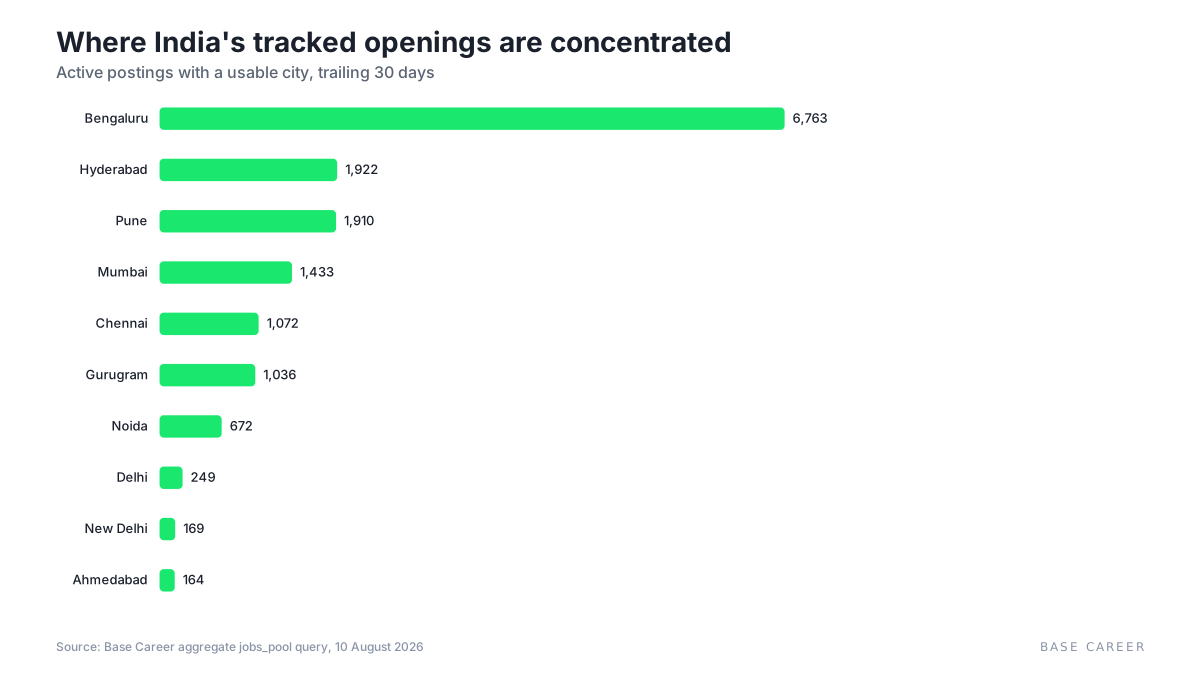
Use this concentration as a planning signal, not a command to relocate. A candidate in Pune with relevant domain experience and a strong network may have a better path than an unfocused candidate applying across Bengaluru. Build a primary city set where you can credibly work, then a secondary set for roles that explicitly support remote or hybrid arrangements. Verify the workplace expectation in each advert and interview process; do not assume that a role tagged remote will remain location-independent.
- Primary market: one or two cities where your experience, network and logistics are strongest.
- Secondary market: a small set of cities you would genuinely relocate to for the right role.
- Remote lane: only roles whose location and working model are clearly stated and workable for you.
- Review lane: postings with missing city data that deserve manual verification before you invest time.
Pick one role lane before rewriting your CV

“I kept getting rejections from London. Base Career rewrote my CV for Dubai, and I landed Emirates in 3 weeks.”
Sarah M. · Marketing Manager · UK 🇬🇧 → Dubai 🇦🇪
No credit card required
Start with a role family narrow enough to produce a coherent story. Software engineering, data engineering, data science and DevOps overlap, but employers usually evaluate different evidence for each. A software engineering application may foreground production systems, code quality and delivery. A data engineering application may foreground pipelines, orchestration, reliability and data modelling. A DevOps application may foreground deployment, observability, cloud operations and incident reduction.
Write down a target statement before editing: role family, realistic level, preferred cities, domain strengths and the problems you can prove you have solved. Then collect several live descriptions for that lane and note recurring language. Do not copy sentences from adverts. Translate genuine experience into the terms employers use only where the meaning is accurate.
- Choose a role family and realistic seniority.
- Collect recurring skills and responsibilities from relevant live adverts.
- Match each priority requirement to evidence from your own work.
- Remove tools and claims you cannot discuss confidently in an interview.
- Create a focused base CV, then tailor it for each serious application.
Build an ATS-readable India tech CV
An ATS-readable CV is not a document stuffed with keywords. It is a clearly structured record that lets software and a recruiter identify your fit quickly. Use conventional headings, simple chronology and text that can be selected and copied. Keep decorative graphics, complex columns and skill ratings out of the core evidence. Put contact details in the document body rather than relying on headers, footers or image elements.
For each recent role, connect action, technical context and outcome. “Improved a service” is vague. A stronger bullet explains what you changed, the environment and the operational or customer result—using a metric only when you can defend its source. If a job description asks for a tool you used, name it naturally beside the relevant achievement. If you have not used it, do not add it merely to pass a filter.
Keep the top section aligned with the role. A short professional summary can state your discipline, experience context and strongest relevant contribution without clichés. Follow it with a compact skills section and evidence-rich employment history. Projects can help career changers and early-career applicants, but they should explain the problem, decisions and result rather than listing a repository link with no context.
Base Career’s current jobs page can help you inspect live role language and move from discovery into a tailored workflow. For a worked example of a market-specific search sequence, see the prior guide on how to get hired in Australia in 2026. The market differs, but the discipline—work eligibility, role focus, readable evidence and measured applications—transfers well.
Prioritise demonstrable skills over trend chasing
The World Economic Forum’s Future of Jobs Report frames technological change, economic uncertainty, demographic shifts and the green transition as forces reshaping work. That broad context is useful, but it should not turn your CV into a list of fashionable terms. The better question is which capabilities repeatedly appear in your chosen lane and which of them you can demonstrate through shipped work, projects, certifications or clear technical discussion.
For structured learning, the Government of India’s Skill India Digital Hub provides skills and opportunity pathways, while the AICTE Internship Portal supports internship discovery. Early-career candidates can use these resources to build evidence, but completion badges alone are not a hiring strategy. Pair learning with a scoped project, documentation and the ability to explain trade-offs.
The International Labour Organization’s India Employment Report offers wider context on youth employment, education and skills. For current labour-market statistics, the Government of India’s Ministry of Statistics and Programme Implementation publishes official releases, including Periodic Labour Force Survey material. These sources provide context; they do not replace the role-level evidence in current adverts.
Run a measured application campaign
Set up a weekly operating rhythm. Discover suitable roles, qualify them against your target statement, tailor the strongest applications, follow up where appropriate and record outcomes. Separate a lack of interviews from a lack of offers. The first points to targeting, CV evidence or application quality; the second may point to interview preparation, role calibration or competition.
Review patterns after a meaningful batch rather than changing strategy after every rejection. If Bengaluru software roles produce relevant recruiter conversations while broad product applications produce none, concentrate effort. If you repeatedly fail technical screens, protect time for practical preparation. If recruiters question level, compare your ownership evidence with the responsibilities attached to the title.
- Track role, company, city, source, application date and CV version.
- Record whether the role was genuinely aligned before counting it as a test.
- Measure recruiter responses, screens, interviews and offers separately.
- Review which skills or examples recur in interviews.
- Change one major variable at a time so you can learn from the result.
Your practical plan for the next week
On the first day, choose one role lane and a primary city set. Next, analyse relevant adverts and map the recurring requirements to your evidence. Rebuild the top half of your CV around that evidence, then test the document for plain-text readability. Prepare two concise project or achievement stories you can explain without notes. Finally, submit a small set of high-fit applications and record exactly what you changed for each.
The objective is not maximum application volume. It is a repeatable system that improves targeting and makes your strongest evidence obvious. India’s tracked technology openings show meaningful software and data demand, but demand alone does not create fit. A specific role thesis, credible skills, city realism and disciplined follow-through give you a better basis for deciding where to invest your time.
Sources and methodology
Base Career figures come from aggregate queries executed on 10 August 2026 over active India postings scraped in the trailing 30 days. Queries grouped records by title, city and employment type and measured salary-field coverage; no individual job descriptions, users, CVs or applications were retrieved. External sources were accessed on 10 August 2026: World Economic Forum, Future of Jobs Report; International Labour Organization, India Employment Report; Skill India Digital Hub; AICTE Internship Portal; and the Ministry of Statistics and Programme Implementation.
Frequently Asked Questions
Which Indian city had the most tracked active postings?+
Which technology role appeared most often?+
Can this data be used for India salary benchmarking?+
Should I apply across every Indian technology hub?+
Land 4x more interviews in 27 days. Join Base Career Today.
Track applications, tailor resumes, and follow up faster in one UAE job search system.
Start freeNo credit card required

James T.
Canada 🇨🇦 → Riyadh 🇸🇦
“50 applications, zero replies with my Canadian CV. Base Career got me 4 Riyadh interviews and a Series B offer.”
Written by Ankush Wadhwa
Helping you accelerate your career with AI-powered tools.
Related Posts

Is it Easy to Get a Job in Dubai From Overseas? The Honest Truth
Dreaming of a tax-free salary in Dubai but living abroad? We analyze the challenges of international applications and share a strategic roadmap for success.

Building 'Wasta' from Scratch: Networking Strategies for Dubai Expats
Frustrated by 1,000+ applicants on LinkedIn? Learn how to build 'Wasta'—your professional network—from zero to access the UAE's hidden job market.