India Job Search 2026: Roles, ATS and Offers
Ankush Wadhwa

Finding a job in India in 2026 is not mainly a question of sending more applications. It is a targeting problem: choose the right role family, search in the locations where employers are posting, make your CV readable by both software and people, and compare the full offer rather than reacting to one headline number. This guide turns fresh Base Career posting data into a practical search system.
Base Career tracked 94,853 active India postings added during the latest 30-day window when this analysis was run on 5 September 2026. That is a large enough pool to reveal useful patterns, but it is not the whole Indian labour market. Treat it as a directional view of jobs available through the sources Base Career currently tracks, not as a census or forecast.
The strongest application is not the longest CV or the fastest click. It is the clearest match between a real vacancy, your evidence and the employer's decision criteria.
What the current India posting pool says
Demand in the tracked pool is broad, but it is not evenly distributed. Software is the largest classified role family with 25,643 postings. Operations follows with 12,385, engineering with 11,588, sales with 7,621, finance with 6,708 and data with 4,615. Another 15,717 postings sit in the broad “other” classification, so use these families as a search map rather than rigid industry boundaries.
The location picture is equally concentrated. Bengaluru leads the named-city results with 22,625 postings, followed by Hyderabad with 8,560, Pune with 8,157, Mumbai with 6,609, Gurugram with 4,914, Chennai with 4,803, Noida with 3,491 and Kolkata with 1,991. A separate 19,146 postings had no usable normalised city, so the chart deliberately excludes that unclassified group.
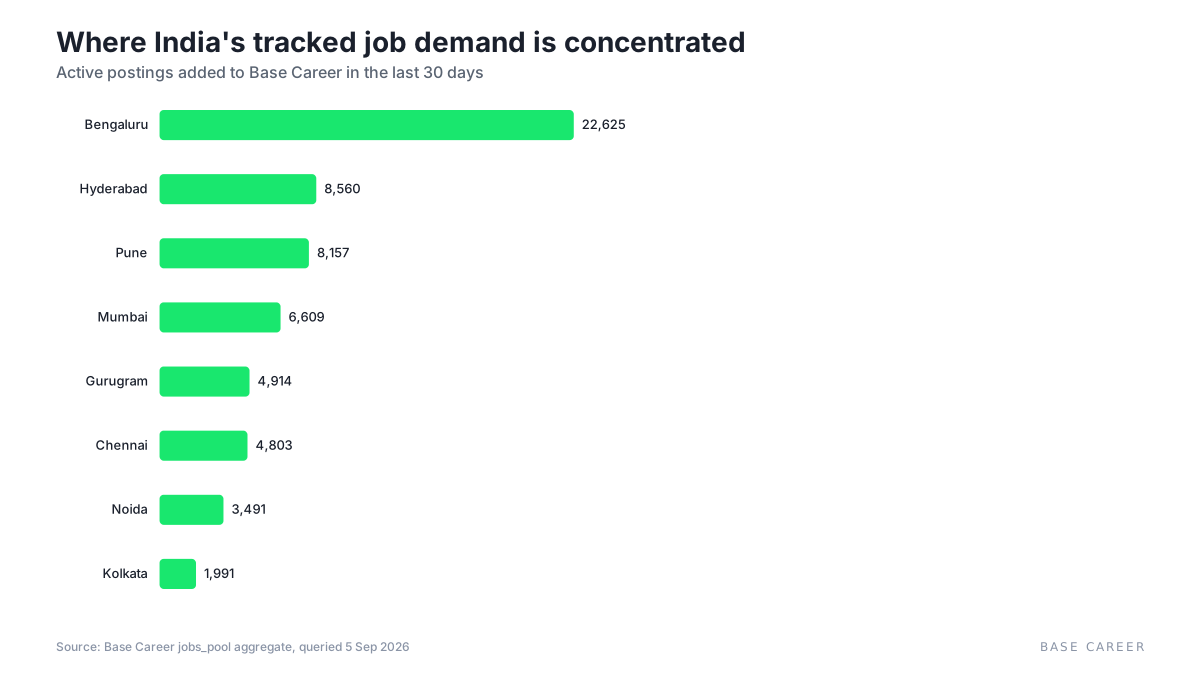
Method: figures above come from aggregate queries over active rows where country = 'IND' and date_scraped fell within the latest 30 days. No individual job descriptions, applicant records or personal data were used. Counts reflect posting records rather than hires, vacancies filled or unique employers.
Choose a lane before you choose job titles
Start with a role family that matches evidence you can already show. If your experience is in software, data or engineering, build searches around the technology, product environment and level you have delivered at. If your background is in operations, sales or finance, lead with the business process, customer type, territory, control or outcome you owned. A generic “manager” search hides the real difference between roles.
Then build a small title map. Put the exact title you hold today in the centre. Around it, add close employer variants, a level above, a level below and the specialist nouns that describe your work. Search those combinations rather than relying on one saved query. This catches employers that describe comparable work differently without pushing you into roles where your evidence is weak.
- Primary lane: the work you can prove with recent outcomes.
- Adjacent lane: a closely related role using most of the same skills.
- Stretch lane: a more senior or specialised role where you can meet the essential criteria.
- Exclude lane: titles that look familiar but require credentials, domain depth or responsibilities you do not have.
Use city data without becoming trapped by it
Bengaluru's lead in this pool makes it a logical starting point for many technology and business-service searches, but the better question is where your role and constraints overlap. Hyderabad and Pune offer substantial tracked volume, while Mumbai, Gurugram, Chennai and Noida can be stronger for particular industries and functions. Search nationally first, then compare the quality of suitable results by city.
Workplace labels also matter. The pool contains 46,212 onsite, 12,039 hybrid and 2,792 remote postings. Another 31,862 were unknown or not specified, with 2,021 field-based roles. Do not read a missing label as permission to work remotely. Confirm the actual location expectation with the employer before investing heavily in a process.
If relocation is possible, state that clearly but honestly. A line such as “Based in Jaipur; available to relocate to Pune after an agreed start date” is more useful than pretending to be local. If relocation is not possible, filter firmly. The goal is not to maximise application volume; it is to avoid interviews that fail when location, commute or attendance expectations finally surface.
You can explore current opportunities on the Base Career jobs page. For a deeper technology-specific view, read our earlier analysis of India tech jobs, cities and skills. Candidates focused on Karnataka can also use the Bengaluru job-search plan as a city-level companion.
Build an ATS-readable CV that still helps a recruiter
An applicant tracking system is a workflow tool, not a single universal gate with one secret scoring formula. Employers configure systems differently. Your safest response is therefore clarity: familiar section names, consistent dates, recognisable titles, plain contact details and language that accurately overlaps with the vacancy.
Begin with a short professional summary that names your target function, relevant domain and strongest evidence. Follow it with a skills section that uses terms you genuinely know. In your experience section, connect each important skill to an outcome or responsibility. A keyword sitting alone proves very little; a sentence showing how you used it gives a human reviewer a reason to continue.

“I kept getting rejections from London. Base Career rewrote my CV for Dubai, and I landed Emirates in 3 weeks.”
Sarah M. · Marketing Manager · UK 🇬🇧 → Dubai 🇦🇪
No credit card required
- Use standard headings such as Summary, Experience, Skills and Education.
- Keep the reading order simple; avoid critical information inside decorative graphics.
- Mirror the employer's accurate terminology without copying whole sentences.
- Spell out an abbreviation the first time if both forms are common in your field.
- Show scope and outcomes you can defend in an interview.
- Export to the format requested by the employer and reopen the file before submitting.
The official National Career Service currently links job search, career centres, skill providers and an AI CV builder from its public portal. It can be a useful additional route, particularly when you want an official government platform alongside employer career sites and reputable private platforms. The Skill India Digital Hub also presents skilling, job and apprenticeship opportunities.
Tailor the CV without rewriting your career
Create a strong master CV, then make a targeted version for each role lane. Change emphasis, not history. Move the most relevant skills and achievements higher, use the employer's accurate vocabulary and remove detail that distracts from the target. Never add a tool, credential, title or result you cannot explain.
Before submitting, mark the essential criteria in the vacancy. Beside each one, write where your evidence appears in the CV. If a criterion is genuinely missing, decide whether the role is still plausible. If the evidence exists but is hard to find, fix the document. This quick test improves both machine readability and human comprehension.
Run a focused application workflow
Use a weekly pipeline with clear stages: researched, tailored, submitted, follow-up due, interviewing and closed. Save the vacancy URL, employer, title, city, submission date, CV version and next action. That record prevents duplicate applications and makes your follow-up specific.
Prioritise roles where the essential work matches your recent evidence. Apply through the employer's official career site when available, then use networking to add context rather than to demand a referral. A useful message is short: identify the role, name the relevant problem you have solved and ask one sensible question. Respect a non-response.
For early-career candidates, internships and structured training can create the evidence a full-time application lacks. The AICTE National Internship Portal describes itself as a government-backed internship platform for students, while the Directorate General of Training is an official reference point for vocational training pathways. Check eligibility and the current programme details on the source before applying.
Compare offers beyond headline CTC
Salary transparency in the tracked India pool is limited: only 4.37% of the 94,853 postings included a non-empty salary field. That makes the job advert a weak standalone benchmark. Do not invent a market rate from a handful of visible postings, and do not assume the highest CTC figure equals monthly take-home pay.
Ask for the offer structure in writing. Separate fixed cash, variable pay, joining or retention payments, employer benefits, equity where relevant, and any amount that depends on performance or continued service. Ask when each component is paid and what conditions apply. Compare like with like across offers and against your real costs of commute, relocation and working pattern.
- What is guaranteed fixed compensation?
- Which components are variable, deferred or conditional?
- What is the performance period and who decides the outcome?
- Which benefits have practical value for you and your family?
- What location, travel, shift or attendance costs will you carry?
- Is every material promise included in the written offer?
For a benchmark, use several comparable roles with the same city, level, function and company type. Public estimates can start a conversation, but your strongest negotiation case is the value and scarcity of your relevant evidence. State the range you are considering, explain what it reflects and remain ready to evaluate the whole package.
Keep official labour-market sources in the loop
Posting data is timely but partial. For broader labour-market context, the Ministry of Statistics and Programme Implementation maintains its Periodic Labour Force Survey product page, and the Ministry of Labour and Employment publishes information through its employment section. Use these official sources to understand definitions and national trends rather than treating one job board as the economy.
The Base Career dataset is better suited to tactical questions such as which named cities and role families are visible now. Official surveys are better suited to population-level questions. Combining both prevents a common mistake: turning a current posting pattern into a claim about every employer or worker in India.
Protect yourself from recruitment scams
The National Career Service displays a warning about fraudulent practices and tells users to verify information through its official website. Treat unexpected payment demands, pressure to share sensitive documents, interviews conducted only through informal messaging and domains that imitate a known employer as reasons to pause and verify independently.
Open the employer's career site yourself rather than trusting a forwarded link. Confirm that the vacancy exists, that the recruiter's domain matches the organisation and that the written process makes sense. Share only the information needed for the current stage. If you encounter a suspicious identifier or cyber-enabled fraud, the official National Cyber Crime Reporting Portal provides complaint and suspect-reporting routes.
A practical search plan for the next fortnight
- Define one primary role family and one adjacent lane.
- Build a title-and-skill map from suitable live vacancies.
- Choose cities and working patterns that fit your real constraints.
- Prepare one master CV and targeted versions for each lane.
- Shortlist roles by evidence match before you apply.
- Track each application, CV version and next action.
- Practise explaining your strongest outcomes in plain language.
- For every offer, request the written component breakdown before comparing pay.
At the end of the fortnight, review conversion rather than raw activity. If suitable applications are not producing screens, inspect role fit, CV clarity and channel choice. If screens are not becoming interviews, improve your examples and answers. If interviews are not becoming offers, ask where your evidence, expectations or role selection may be misaligned.
Sources and data provenance
Base Career data: aggregate queries of public.jobs_pool on the self-hosted production database, executed 5 September 2026. Filters used active postings, country = 'IND' and the latest 30-day scrape window. Queries covered total coverage, role families, city, workplace type, employment type and salary-field presence.
- National Career Service — https://www.ncs.gov.in/ — accessed 5 September 2026.
- Skill India Digital Hub — https://www.skillindiadigital.gov.in/home — accessed 5 September 2026.
- AICTE National Internship Portal — https://internship.aicte-india.org/ — accessed 5 September 2026.
- Directorate General of Training — https://dgt.gov.in/ — accessed 5 September 2026.
- Ministry of Statistics and Programme Implementation, PLFS product page — https://www.mospi.gov.in/themes/product/69-periodic-labour-force-survey-plfs — accessed 5 September 2026.
- Ministry of Labour and Employment, Employment — https://www.labour.gov.in/employment — accessed 5 September 2026.
- National Cyber Crime Reporting Portal — https://cybercrime.gov.in/ — accessed 5 September 2026.
Frequently asked questions
Frequently Asked Questions
Which Indian city has the most jobs in Base Career's current data?+
Should I use the same CV for every application?+
Does an ATS reject every CV without exact keywords?+
How should I compare CTC across offers?+
Where can I check official job-search and training resources?+
A good India job search is a sequence of evidence-based choices. Use the current market data to narrow the field, use a readable CV to make your fit visible, and use a written offer breakdown to protect the decision at the end. That is slower than indiscriminate clicking, but it creates a search you can measure and improve.
Land 4x more interviews in 27 days. Join Base Career Today.
Tailor your resume for every role with a workflow built for faster applications.
Start freeNo credit card required

James T.
Canada 🇨🇦 → Riyadh 🇸🇦
“50 applications, zero replies with my Canadian CV. Base Career got me 4 Riyadh interviews and a Series B offer.”
Written by Ankush Wadhwa
Helping you accelerate your career with AI-powered tools.
Related Posts

Is it Easy to Get a Job in Dubai From Overseas? The Honest Truth
Dreaming of a tax-free salary in Dubai but living abroad? We analyze the challenges of international applications and share a strategic roadmap for success.

Landing Your First Dubai Job: A Roadmap for Freshers and Graduates
Breaking into the UAE job market with zero experience is tough but not impossible. Here is your strategic roadmap to landing that first role in Dubai.