How to Get Hired in Australia in 2026: A Practical Guide
Ankush Wadhwa

Getting hired in Australia is not one generic process. Your strongest route depends on whether you already have unrestricted work rights, need employer sponsorship, or qualify for an independent skilled pathway. It also depends on whether your experience matches the language Australian employers use in job adverts. This guide gives you a practical sequence: establish your work-rights position, choose a narrow role and city target, build an ATS-readable résumé, and run a measured application campaign.
Base Career tracked 6,767 active Australian postings in the trailing 30 days to 10 August 2026. This is a directional sample of the market, not a census of every vacancy.
Start with work rights, not applications
Before rewriting your résumé, identify the exact basis on which you can work. The Australian Department of Home Affairs says that anyone coming to Australia to work needs a visa suited to the work they intend to do. Its Working in Australia hub is the correct starting point for current pathways and conditions (accessed 10 August 2026). Do not describe yourself as work-authorised if your permission is conditional, pending or tied to a different activity.
Some candidates may investigate employer sponsorship. Home Affairs describes the Skills in Demand visa, subclass 482, as a temporary route through which an employer sponsors a suitably skilled worker for a position it cannot fill with a suitably skilled Australian worker. Other candidates may investigate the Skilled Independent visa, subclass 189, which Home Affairs describes as a permanent route for invited workers with skills Australia needs. These descriptions are not a promise of eligibility. Use the official subclass 482 and subclass 189 pages (accessed 10 August 2026), then seek registered professional advice if your case is unclear.
For skilled routes, occupation eligibility can matter. Home Affairs maintains a skilled occupation list that summarises occupations used to address shortages (accessed 10 August 2026). Check the current list and the requirements of the specific visa rather than relying on a recruiter, social post or old checklist. Visa rules, lists and evidence requirements can change.
What current Australian postings show
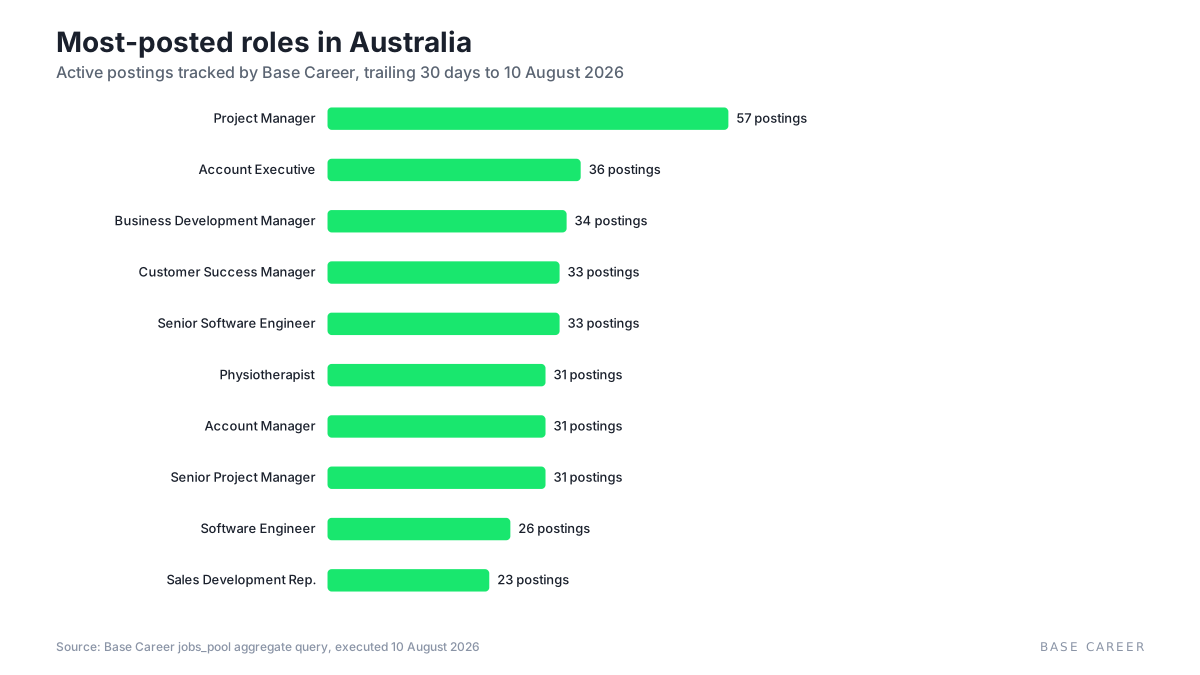
Base Career’s aggregate query found 6,767 active Australian postings scraped during the latest 30-day window. Project Manager was the most frequently repeated exact title in the sample with 57 postings. Account Executive followed with 36, while Business Development Manager had 34. Customer Success Manager and Senior Software Engineer each appeared 33 times. These are exact-title counts, so closely related titles are not merged; use them as clues for keyword research, not as a national ranking of occupations.
Location concentration is also visible. The same query found 2,181 postings associated with Sydney, 1,441 with Melbourne, 549 with Brisbane, 374 with Perth, 280 with Adelaide and 173 with Canberra. Another 1,408 postings had no usable city value. That missing-location group is a reminder not to over-interpret city shares: source coverage and incomplete fields shape the sample.
Salary fields were present in only about 0.8% of this Australian sample. That coverage is too thin for a credible salary benchmark, so this guide does not calculate one from Base Career data. For national labour-market context, consult the Australian Bureau of Statistics’ Labour Force, Australia release (accessed 10 August 2026), and compare any pay claim against the role, seniority, location and employment arrangement you are considering.
Choose a role-first search strategy

“I kept getting rejections from London. Base Career rewrote my CV for Dubai, and I landed Emirates in 3 weeks.”
Sarah M. · Marketing Manager · UK 🇬🇧 → Dubai 🇦🇪
No credit card required
A broad search for “any professional job in Australia” produces a broad, weak résumé. Choose one primary role family and one adjacent family. A project professional might target Project Manager and Senior Project Manager positions; a commercial candidate might target Account Executive and Business Development Manager positions. Read a representative set of current adverts and build a vocabulary list covering outcomes, tools, stakeholders, sector language and mandatory credentials.
Then decide whether your search is national or city-led. Sydney and Melbourne dominate Base Career’s current sample, but the right city is the one where your role, work rights and personal constraints intersect. Search current jobs in Australia, record which locations repeatedly advertise your target role, and avoid relocating on the strength of one advert. If an employer requires on-site work, make your location and realistic availability clear.
Build an Australian ATS-ready résumé
Your résumé should be easy for software and people to scan. Use conventional headings such as Summary, Experience, Education and Skills. Keep dates, employers and job titles in a predictable structure. Avoid important information inside decorative graphics, text boxes or multi-column layouts that can be read out of order. Match the employer’s terminology where it accurately reflects your experience; never insert skills you do not have.
Lead each experience section with evidence of scope and outcomes. Replace a duty such as “responsible for projects” with a truthful description of what you delivered, for whom, under what constraints and with what result. Quantify only when you can defend the number. If you are applying from overseas, state your current location and work-rights position accurately near the top, without turning the résumé into an immigration essay.
Australian English is the safer default for spelling and tone. Keep the writing direct, specific and free of exaggerated claims. Remove a photograph and unrelated personal details unless there is a legitimate role-specific reason to include them. Before submitting, export a clean PDF only when the employer accepts it; otherwise follow the requested file format. For a deeper formatting checklist, compare Base Career’s prior guide to building an ATS-readable CV, adapting its structural principles rather than its UAE-specific details.
Run a measured application campaign
Quality and feedback loops matter more than uncontrolled volume. Create a shortlist of employers and submit tailored applications where you meet the essential criteria. For each application, record the source, role family, city, work-rights requirement, submission date and outcome. Review the pattern weekly. If relevant applications produce no screening calls, the problem may be targeting, résumé evidence or work-rights fit rather than a need to submit more of the same.
- Confirm your current work rights using official Home Affairs information.
- Choose one primary role family and one adjacent role family.
- Select realistic locations based on current demand and your constraints.
- Build a plain, ATS-readable résumé using Australian English.
- Tailor evidence and keywords truthfully for each suitable vacancy.
- Track responses and change one variable at a time.
Networking should support, not replace, a credible application. Contact people with a specific reason: shared discipline, sector knowledge or a thoughtful question about the team’s work. Do not ask strangers to secure a visa or guarantee an interview. A useful conversation can clarify local terminology, hiring cycles and how your overseas experience translates, but the application still needs to show role fit.
If you are applying from overseas
Overseas candidates should separate three questions: can the employer hire you, does the role justify the complexity, and can you demonstrate a stronger fit than locally available applicants? Answer the first question accurately in every form. For sponsorship-dependent applications, focus on roles and employers where sponsorship is plausible and where your specialist experience is genuinely relevant. Do not conceal your location or choose an incorrect work-authorisation response to pass a filter.
Prepare interview availability across time zones and explain when you could realistically start. Research credential recognition or occupational registration before applying to regulated work. The skilled occupation list is not the same thing as a professional licence, and a visa pathway does not automatically authorise practice in a regulated occupation. Verify both the immigration requirement and the relevant Australian regulator’s current rules for your profession.
A practical plan for your next week
Begin by saving the official visa pages relevant to your circumstances and writing a one-sentence, accurate work-rights statement. Next, identify your primary role and analyse current adverts for recurring language. Rewrite the top third of your résumé around that target, then improve the most relevant experience bullets. Finally, submit a small set of carefully matched applications and record the outcome. The objective is not to predict the whole Australian labour market. It is to create a search that is legally accurate, commercially credible and easy to improve.
Frequently Asked Questions
Can I get an Australian job without permanent residency?+
Should I use the same résumé for every Australian job?+
Which Australian city has the most opportunities?+
Does appearing on a skilled occupation list guarantee a visa?+
Sources and methodology
External sources accessed 10 August 2026: Australian Department of Home Affairs — Working in Australia; Skilled occupation list; Skills in Demand visa (subclass 482); Skilled Independent visa (subclass 189); and Australian Bureau of Statistics — Labour Force, Australia, June 2026. Base Career figures come from aggregate queries over active Australian postings scraped in the trailing 30 days. No individual job descriptions, users, résumés or applications were retrieved.
Land 4x more interviews in 27 days. Join Base Career Today.
Tailor your resume for every role with a workflow built for faster applications.
Start freeNo credit card required

James T.
Canada 🇨🇦 → Riyadh 🇸🇦
“50 applications, zero replies with my Canadian CV. Base Career got me 4 Riyadh interviews and a Series B offer.”
Written by Ankush Wadhwa
Helping you accelerate your career with AI-powered tools.
Related Posts

Is it Easy to Get a Job in Dubai From Overseas? The Honest Truth
Dreaming of a tax-free salary in Dubai but living abroad? We analyze the challenges of international applications and share a strategic roadmap for success.

Landing Your First Dubai Job: A Roadmap for Freshers and Graduates
Breaking into the UAE job market with zero experience is tough but not impossible. Here is your strategic roadmap to landing that first role in Dubai.