Finding Work in London: A Data-Backed 2026 Playbook
Ankush Wadhwa

London is a deep job market, but breadth can become noise. The strongest search is not “apply everywhere”; it is a repeatable system that connects a defined role family, evidence from current vacancies, a readable CV and an honest work-rights position. This guide combines fresh Base Career posting aggregates with current UK public guidance so you can make those decisions with less guesswork.
A focused London search begins with a role hypothesis, not a hundred browser tabs.
London job market snapshot
The wider UK market is competitive. The Office for National Statistics labour market release estimated the UK employment rate at 75.1% for people aged 16 to 64 and the unemployment rate at 4.9% for people aged 16 and over in April to June 2026. These national indicators do not predict an individual outcome, but they are useful context: a London application still needs precise positioning.
Base Career’s production job pool showed 18,491 active UK postings scraped in the trailing 30 days when queried on 27 August 2026. Of those, 7,911 were tagged to London. This is a live inventory snapshot, not an estimate of every vacancy in the economy, and counts can change as roles open, close or are refreshed.
- Population: active postings in the Base Career aggregate job pool.
- Geography: UK records use the GBR country code; London uses the normalised city where available.
- Window: records scraped during the trailing 30 days at query time.
- Privacy: only aggregate counts were used; no applicant, user or individual job-description data was retrieved.
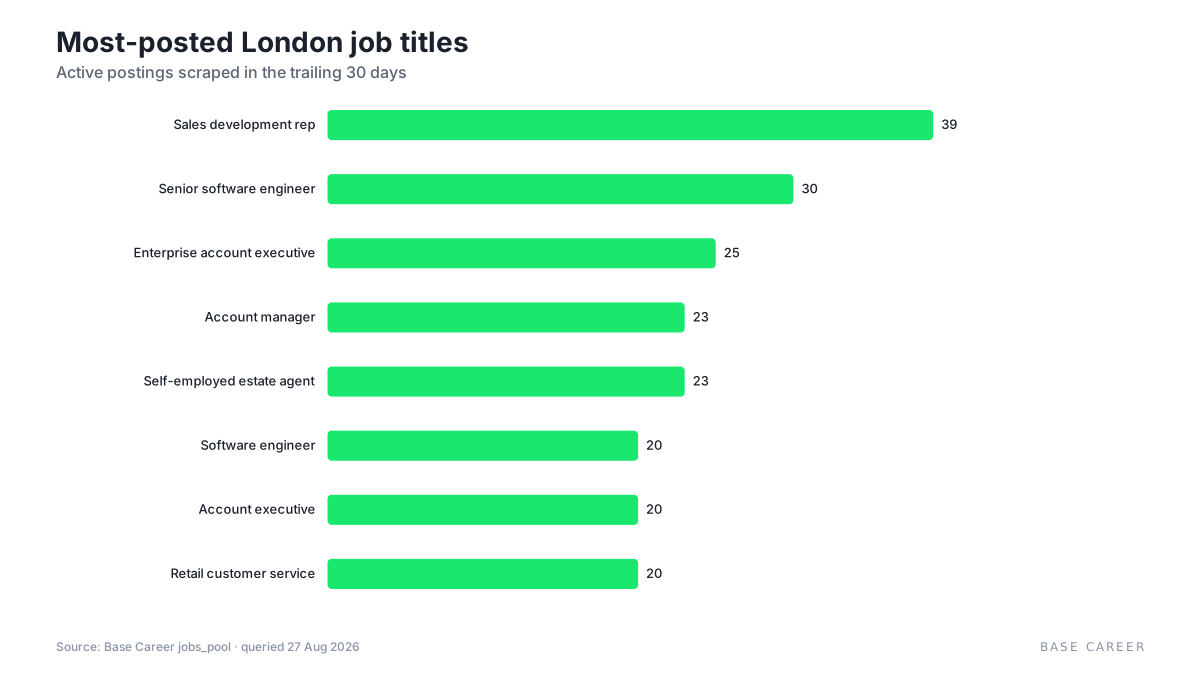
The title-level view is mixed rather than dominated by one profession. Sales development representative led the snapshot with 39 postings, followed by senior software engineer with 30. Enterprise account executive, account manager, estate agency, software engineering and customer-service titles also appeared near the top. Treat these counts as signals for where to inspect live vacancies, not as a promise that a role is easy to win.
What the data does—and does not—tell you
Posting volume can reveal repeated titles and where employers are actively advertising. It cannot tell you how many qualified candidates applied, whether a role was filled internally, how strict a hiring manager will be, or whether a vacancy supports immigration sponsorship. Those questions require advert-level and employer-level checks.
Salary analysis is especially weak in this snapshot. Only 383 of 18,491 UK postings had a non-empty salary field, equal to 2.1%. That coverage is too thin to support a defensible London salary benchmark, so this guide does not turn the pool into a pay claim. Use published ranges in the specific advert and reputable market research for the role you are pursuing.
Choose a role lane before you search
Start with one role family that matches your strongest evidence. A role family is broader than one exact title but narrower than an industry. For example, “commercial growth” can include sales development, business development, account executive and account manager roles. “Software delivery” can include software engineer, senior software engineer and closely related platform roles.
Write a short role hypothesis: the business problem you solve, the environment where you have solved it and the level at which you can operate. This becomes the filter for vacancies, CV bullets, networking messages and interview examples. If a vacancy does not fit the hypothesis, pause before spending time on it.
- Commercial growth: show pipeline creation, conversion, retention or account expansion with clear context.
- Software and data: show systems shipped, reliability improved, users supported or decisions enabled.
- Customer and operations: show service quality, response improvement, process control or stakeholder coordination.
- Property and agency: check employment status, commission terms and regulatory expectations before treating the role like a standard salaried post.
Use a layered London search
Begin with the Base Career UK jobs page and narrow by role language that employers actually use. Then widen your coverage using the National Careers Service guidance on advertised vacancies. Its practical routes include company websites, recruitment agencies, sector publications and professional networks—not just major job boards.
Build a target-employer list alongside your vacancy alerts. This matters because job titles are inconsistent: two employers may describe similar work with different names. Review each employer’s careers page, location policy and hiring process. If sponsorship is relevant, check the official sponsor register before investing heavily in an application.

“I kept getting rejections from London. Base Career rewrote my CV for Dubai, and I landed Emirates in 3 weeks.”
Sarah M. · Marketing Manager · UK 🇬🇧 → Dubai 🇦🇪
No credit card required
Make location part of your decision
“London” can describe very different working patterns. A role may be office-based, hybrid, field-based or attached to a team outside the centre. Read the advert for the expected workplace, then test the commute at the times you would actually travel. A prestigious postcode does not compensate for a routine you cannot sustain.
Do not filter only by landmark districts. Search by role, employer and working pattern, then assess location. That order reduces the chance of overlooking suitable work in outer boroughs or roles advertised under a broader UK location.
Tailor your CV for evidence, not decoration
The National Careers Service CV guidance recommends clear formatting, headings and bullet points, and says your CV should be tailored to the job. That is a useful standard for London applications: a recruiter should be able to understand your fit without decoding dense design or generic claims.
Before submitting, compare the advert with your CV. Keep the employer’s truthful role language where it matches your experience. Move the most relevant evidence higher, cut material that distracts from the target role, and make each achievement understandable to someone outside your previous company.
- Lead with relevance: make the opening profile describe the target work and your credible level.
- Use proof: pair responsibilities with outcomes, scope or constraints you can explain in an interview.
- Keep language natural: include important role terms only where they accurately describe your experience.
- Check readability: use consistent headings, spacing and bullet structure; avoid visual clutter.
- Review contact details: make your location and work-rights statement accurate rather than strategically vague.
Handle work rights and sponsorship accurately
If you already have UK work rights, be ready to prove them through the route that applies to you. GOV.UK explains how candidates can prove their right to work, while separate official guidance explains the employer check. Do not send identity documents through an unverified channel simply because someone claims to be recruiting.
If you need sponsorship, do not treat every London vacancy as eligible. The official Skilled Worker visa overview says the route requires an approved UK employer, a certificate of sponsorship, an eligible occupation and the applicable salary requirement. The details depend on the role and the applicant’s circumstances, so check the current official rules rather than relying on an old social post or a recruiter’s shorthand.
Use the current register of licensed worker sponsors to confirm whether an employer appears on the official list. Presence on the register does not mean every vacancy will be sponsored; absence is a reason to verify before building your plan around that employer.
Be direct about work rights. Accuracy saves time for you and the employer, and it protects you from building a search around roles that cannot proceed.
Create an application workflow you can audit
A good workflow separates discovery from submission. During discovery, save roles that match your lane and note the closing date, location, working pattern and work-rights language. During submission, tailor the CV, answer the employer’s questions and record exactly what you sent. This makes follow-up more credible and interview preparation much easier.
- Role fit: which requirements are essential, and which are preferences?
- Evidence fit: which examples prove you can do the work?
- Practical fit: can you meet the location and working pattern?
- Work-rights fit: is your position clear, and is sponsorship genuinely available if required?
- Process fit: did you apply through a verified employer or agency channel?
Track outcomes by role family rather than judging the whole search emotionally. If you are repeatedly screened out before interview, inspect role level, essential requirements, work-rights fit and CV evidence. If interviews start but offers do not follow, shift attention to examples, role understanding and interview execution.
Avoid the volume trap
High application volume can feel productive while hiding weak targeting. A smaller set of well-matched applications gives you clearer feedback: you can see which role language earns responses, which evidence resonates and where the process breaks. The aim is not to make every application perfect; it is to make each one deliberate enough to learn from.
Also avoid copying vacancy wording wholesale. Use the advert to understand the employer’s needs, then describe your own experience in your own words. That protects accuracy and produces stronger interview stories than a CV built from borrowed phrases.
When another city may be the better comparison
London is not the only market where a city-led search can work. If you are comparing relocation options, the Base Career Toronto jobs guide shows how the same method—current posting evidence, work-right checks and a focused role plan—can be applied in a different country without assuming the rules are interchangeable.
A practical next step
Choose the role family that best matches your evidence, open the live UK jobs page, and save only vacancies you could explain confidently to a hiring manager. Then verify location, work-rights requirements and the employer channel before tailoring your CV. That sequence turns “find a job in London” from a broad ambition into a testable search strategy.
Sources and methodology
External sources were fetched and checked on 27 August 2026. Base Career figures came from aggregate production queries executed on the same date against active GBR records; no individual job descriptions, users or applicants were retrieved.
- Office for National Statistics: Labour market overview, UK — accessed 27 August 2026.
- GOV.UK: Skilled Worker visa overview — accessed 27 August 2026.
- GOV.UK: Prove your right to work — accessed 27 August 2026.
- GOV.UK: Checking a job applicant’s right to work — accessed 27 August 2026.
- GOV.UK: Register of licensed sponsors—workers — accessed 27 August 2026.
- National Careers Service: How to write a CV — accessed 27 August 2026.
- National Careers Service: Advertised job vacancies — accessed 27 August 2026.
Frequently asked questions
Frequently Asked Questions
What jobs are appearing most often in London in the Base Career snapshot?+
Should I use the Base Career data as a London salary guide?+
How do I know whether a London employer can sponsor a Skilled Worker visa?+
What should I put on my CV for London roles?+
Where should I search for London vacancies?+
Land 4x more interviews in 27 days. Join Base Career Today.
Track applications, tailor resumes, and follow up faster in one UAE job search system.
Start freeNo credit card required

James T.
Canada 🇨🇦 → Riyadh 🇸🇦
“50 applications, zero replies with my Canadian CV. Base Career got me 4 Riyadh interviews and a Series B offer.”
Written by Ankush Wadhwa
Helping you accelerate your career with AI-powered tools.
Related Posts

Landing Your First Dubai Job: A Roadmap for Freshers and Graduates
Breaking into the UAE job market with zero experience is tough but not impossible. Here is your strategic roadmap to landing that first role in Dubai.

Is it Easy to Get a Job in Dubai From Overseas? The Honest Truth
Dreaming of a tax-free salary in Dubai but living abroad? We analyze the challenges of international applications and share a strategic roadmap for success.