Canada Job Search in 2026: Roles, Cities and Permits
Ankush Wadhwa

Canada’s job market is large, but a large market is not automatically an easy one. The strongest search starts by separating three questions: which roles match your evidence, where employers are posting, and whether you already have the right to work or need an immigration pathway. This guide combines current aggregate posting data from Base Career with official Government of Canada resources so you can build a focused plan rather than send the same application everywhere.
The posting figures in this guide are based on 27,804 active Canadian postings tracked by Base Career and scraped in the 30 days before 11 August 2026. They describe this pool, not every vacancy in Canada.
What the current posting pool shows
The current pool points to a broad mix of customer-facing, analytical, product, sales and project work. Customer Service Representative was the most repeated exact title, with 255 postings. Business Analyst followed with 194, Product Manager with 180 and Sales Representative with 168. Senior Product Manager appeared in 149 postings. These are exact-title counts, so related titles may sit in separate groups; use them as directional evidence, not a complete occupation forecast.
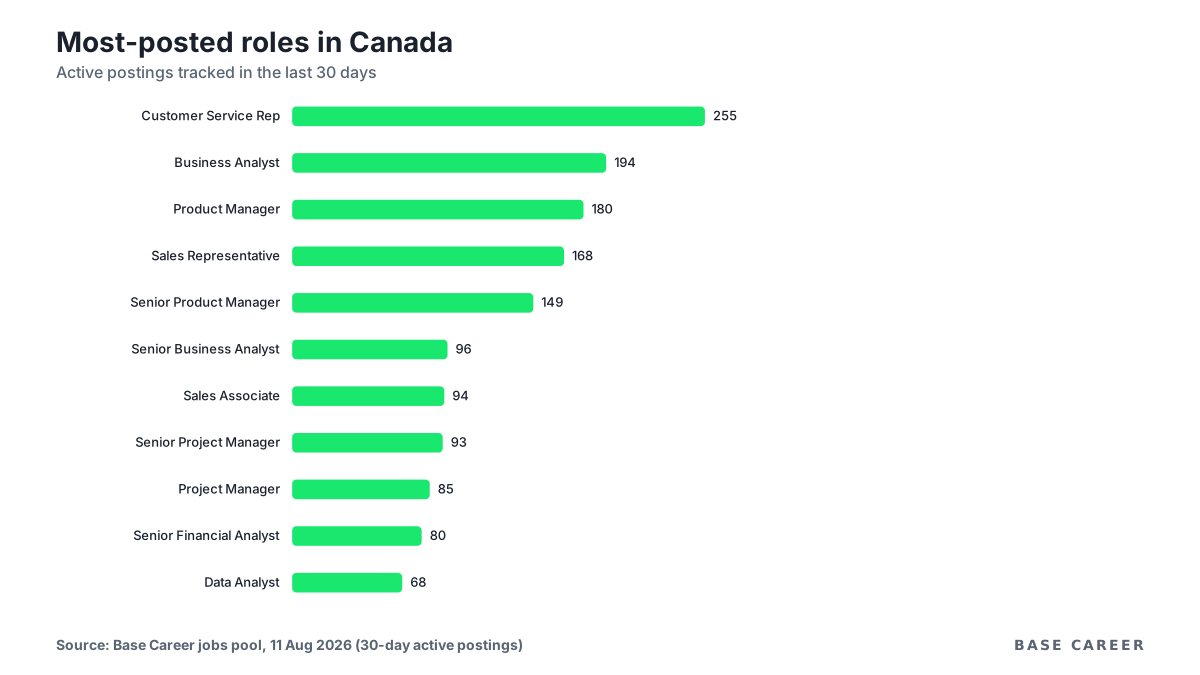
The next tier reinforces the value of transferable business skills. Senior Business Analyst had 96 postings, Sales Associate 94, Senior Project Manager 93, Project Manager 85, Senior Financial Analyst 80 and Data Analyst 68. A candidate who searches only one title may miss adjacent work. A better approach is to build a small role family: one primary title, two close alternatives and a short list of specialist variants that genuinely fit your experience.
Do not interpret an exact-title chart as a ranking of whole occupations. Employers describe similar work differently, and the pool may contain separate records for different title forms. Use the chart to generate search terms, then read the responsibilities. A Product Manager role focused on payments can require very different evidence from one focused on internal operations. Likewise, a Business Analyst vacancy may lean towards process design, reporting, technology delivery or regulatory work.
Choose cities with clean data, not assumptions
Toronto was the largest named city in the current pool, with 3,587 postings. Vancouver had 1,001, Calgary 899, Montréal 707, Ottawa 537, Edmonton 524, Mississauga 345 and Winnipeg 286. However, 14,532 records were grouped as Other and 3,200 had no usable city value. That quality caveat matters: the named-city ranking is useful for creating search lanes, but it cannot support a claim that one city represents the entire Canadian market.
Use location as a testable hypothesis. Start with the city where your network, language ability, sector and work authorisation create the best fit. Then add one alternative market rather than applying nationwide without context. For Toronto, that may mean product, finance, business analysis or customer operations. For Ottawa, government-adjacent experience and bilingual requirements may affect fit. For Montréal, read every language requirement carefully instead of assuming an English-only application will qualify.
Remote labels also need care. The employment-type field in the current pool mixes work arrangements and contract types, and its values are not fully normalised. A vacancy described as remote may still restrict the employee to a province or to Canada. Confirm the stated work location, payroll geography and time-zone expectations on the employer’s page before treating it as location-independent.
Do not infer salary norms from this dataset
Only about 1.9% of the current Base Career Canada pool carried a non-empty salary field. That is too sparse for a responsible salary benchmark. Use the Government of Canada’s Job Bank wage and labour-market tools, employer ranges, collective agreements where relevant and current recruiter evidence. Compare like with like: province, city, occupation level, employment type and required credentials can all change the range.
When a vacancy provides a range, assess its scope before comparing it with another. Check whether the figure is hourly or annual, whether variable pay is separate, and whether the role is permanent, fixed-term or contract. Do not turn an hourly contract number into an annual promise without accounting for unpaid time, benefits and contract duration. The current Base Career sample supports a demand story, not a compensation story.

“I kept getting rejections from London. Base Career rewrote my CV for Dubai, and I landed Emirates in 3 weeks.”
Sarah M. · Marketing Manager · UK 🇬🇧 → Dubai 🇦🇪
No credit card required
Work authorisation comes before application volume
The official Government of Canada Work in Canada hub distinguishes employer-specific and open work permits. It states that an employer-specific permit requires a job offer, while an open permit does not, and it directs applicants to the eligibility and application instructions for their circumstances. Do not describe yourself as authorised to work until your actual status supports that statement.
For skilled immigration, the official Express Entry page explains that the online system manages applications under the Canadian Experience Class, Federal Skilled Worker Program and Federal Skilled Trades Program. A job application is not an immigration application, and an employer conversation is not a permit approval. Keep the two workstreams connected but administratively separate.
Job Bank’s foreign-candidate guidance gives a practical order: confirm eligibility, check whether qualifications are recognised, then search jobs open to international candidates. That sequence is especially important in regulated occupations. The same page points candidates to the Foreign Credential Recognition tool, which identifies whether an occupation is regulated and where to investigate recognition requirements.
Rules and personal eligibility can change. Use official tools for your own circumstances and obtain qualified advice where needed. This guide does not determine immigration eligibility and does not replace legal advice. Its purpose is to stop avoidable job-search mistakes: claiming a status you do not hold, targeting vacancies that require unavailable authorisation, or overlooking a credential requirement until late in the process.
Build a Canadian application around evidence
A strong résumé makes relevance easy to verify. Lead with a concise target and recent evidence, not a long personal profile. For each role, show the problem, your action and the outcome in plain language. Keep titles honest while adding context that a Canadian recruiter can understand. Replace internal acronyms with the underlying function, and mirror the vacancy’s terminology only when it accurately describes your work.
Create one résumé version for each role family rather than one version for every vacancy. Put the most relevant recent achievements near the top of each role. Use measurable outcomes only when you can substantiate them. State your location and work-authorisation position accurately and briefly. Check whether your occupation requires provincial or professional recognition before claiming eligibility.
Before applying, compare your résumé with the vacancy on responsibilities, tools, seniority and domain. If the role asks for stakeholder management, the evidence should show who you influenced and what changed. If it asks for analysis, show the decision your analysis supported. If it asks for customer operations, show service quality, volume or process improvement without exposing confidential employer or customer information.
Avoid decorative keyword stuffing. An applicant-tracking system may help organise applications, but a recruiter still needs coherent evidence. Repeatedly adding a tool name without showing where you used it weakens trust. A compact skills section can help discovery; the employment evidence should prove the important claims.
A focused weekly job-search workflow
Begin with discovery. Review a bounded set of new vacancies, remove roles that fail essential eligibility requirements and group the remainder by recurring skill gaps. Next, tailor and submit only the applications where your evidence is credible. Then follow up through an appropriate professional channel when the employer provides one. End the week by reviewing response quality, not just application volume.
Track the title, employer, city, source, date, résumé version, work-authorisation requirement and next action. This prevents duplicate applications and shows which role family earns replies. Use Base Career’s job search to explore current opportunities. The prior India technology-jobs guide also demonstrates how role and city evidence can become a practical search strategy rather than a list of popular keywords.
Measure outcomes in stages. A low rate of qualified applications may mean your search filters are too broad. Applications that produce views but no conversations may signal weak evidence or poor role fit. Interviews that repeatedly stall at the same question point to a preparation gap. Change one part of the process at a time so the next result teaches you something.
Networking should support, not replace, relevance. Ask focused questions about the team, role and local market instead of opening with a request for sponsorship or referral. A useful conversation can clarify title variations, required credentials and realistic hiring cycles. Record those lessons and update your role family or city hypothesis.
Common mistakes to avoid
- Applying to regulated work before checking recognition requirements.
- Claiming sponsorship, permit eligibility or work authorisation without confirming official rules.
- Treating a broad national posting count as proof of demand in one city.
- Using salary fields from a sparse posting sample as a market benchmark.
- Changing titles or responsibilities so heavily that the résumé becomes difficult to verify.
- Sending high volume without measuring which applications produce qualified responses.
- Assuming a remote label removes provincial, payroll or residency restrictions.
- Using one generic résumé for unrelated role families.
Your next step
Choose one primary role family and one Canadian market. Confirm the occupation’s credential requirements and your work-authorisation pathway using official sources. Build a résumé that proves the recurring skills in current vacancies, then run a short, measured application cycle. Expand only when the evidence tells you what is working. That discipline will not remove competition, but it will make every application more relevant, more honest and easier for an employer to assess.
Sources and methodology
All sources were accessed on 11 August 2026.
- Base Career self-hosted jobs_pool aggregate queries executed this run: Canadian coverage, exact-title counts, city counts, salary-field share, employment-type mix and posting lifetime.
- Government of Canada, Jobs: https://www.canada.ca/en/services/jobs.html
- IRCC, Work in Canada: https://www.canada.ca/en/immigration-refugees-citizenship/services/work-canada.html
- IRCC, Express Entry: https://www.canada.ca/en/immigration-refugees-citizenship/services/immigrate-canada/express-entry.html
- Government of Canada Job Bank, Foreign candidates: https://www.jobbank.gc.ca/findajob/foreign-candidates
- Statistics Canada, Subjects: https://www150.statcan.gc.ca/n1/en/subjects
Land 4x more interviews in 27 days. Join Base Career Today.
Track applications, tailor resumes, and follow up faster in one UAE job search system.
Start freeNo credit card required

James T.
Canada 🇨🇦 → Riyadh 🇸🇦
“50 applications, zero replies with my Canadian CV. Base Career got me 4 Riyadh interviews and a Series B offer.”
Written by Ankush Wadhwa
Helping you accelerate your career with AI-powered tools.
Related Posts

Is it Easy to Get a Job in Dubai From Overseas? The Honest Truth
Dreaming of a tax-free salary in Dubai but living abroad? We analyze the challenges of international applications and share a strategic roadmap for success.

Landing Your First Dubai Job: A Roadmap for Freshers and Graduates
Breaking into the UAE job market with zero experience is tough but not impossible. Here is your strategic roadmap to landing that first role in Dubai.